Three terms, in plain words
- Provisional application: a lower-cost first filing that gives you a date. A full application filed within twelve months can claim that date, but only for what the provisional actually describes.
- Written description: the legal requirement that a filing show you had the invention in hand at the time, in enough detail that a skilled person could see you possessed it. Not a sketch. Not an aspiration.
- Prior art: anything already public that shows an idea is not new, plus certain patent applications filed before yours even if they were not yet public. Whether a third party's filing counts as "before yours" turns out to be a harder question than it sounds.
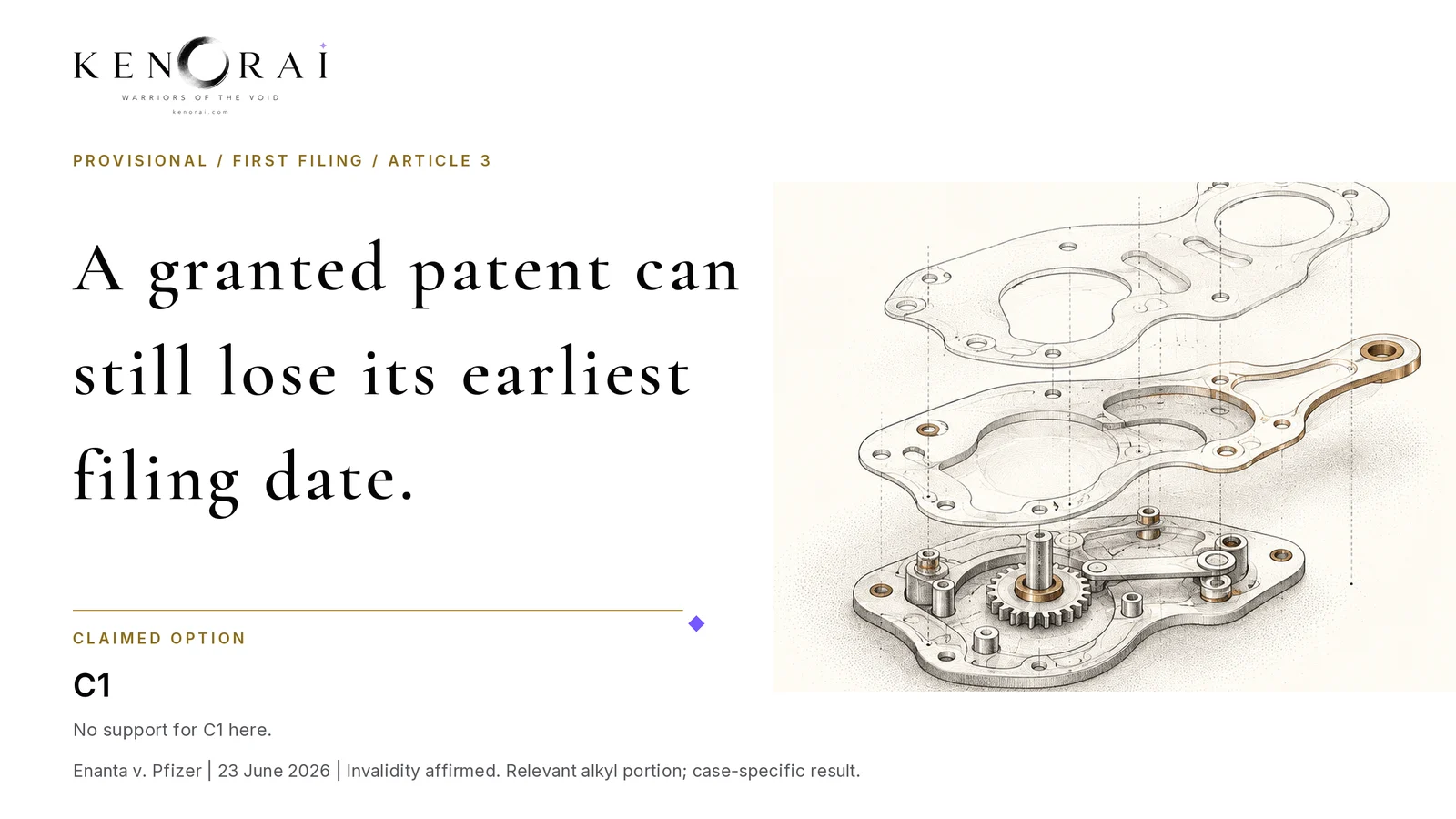
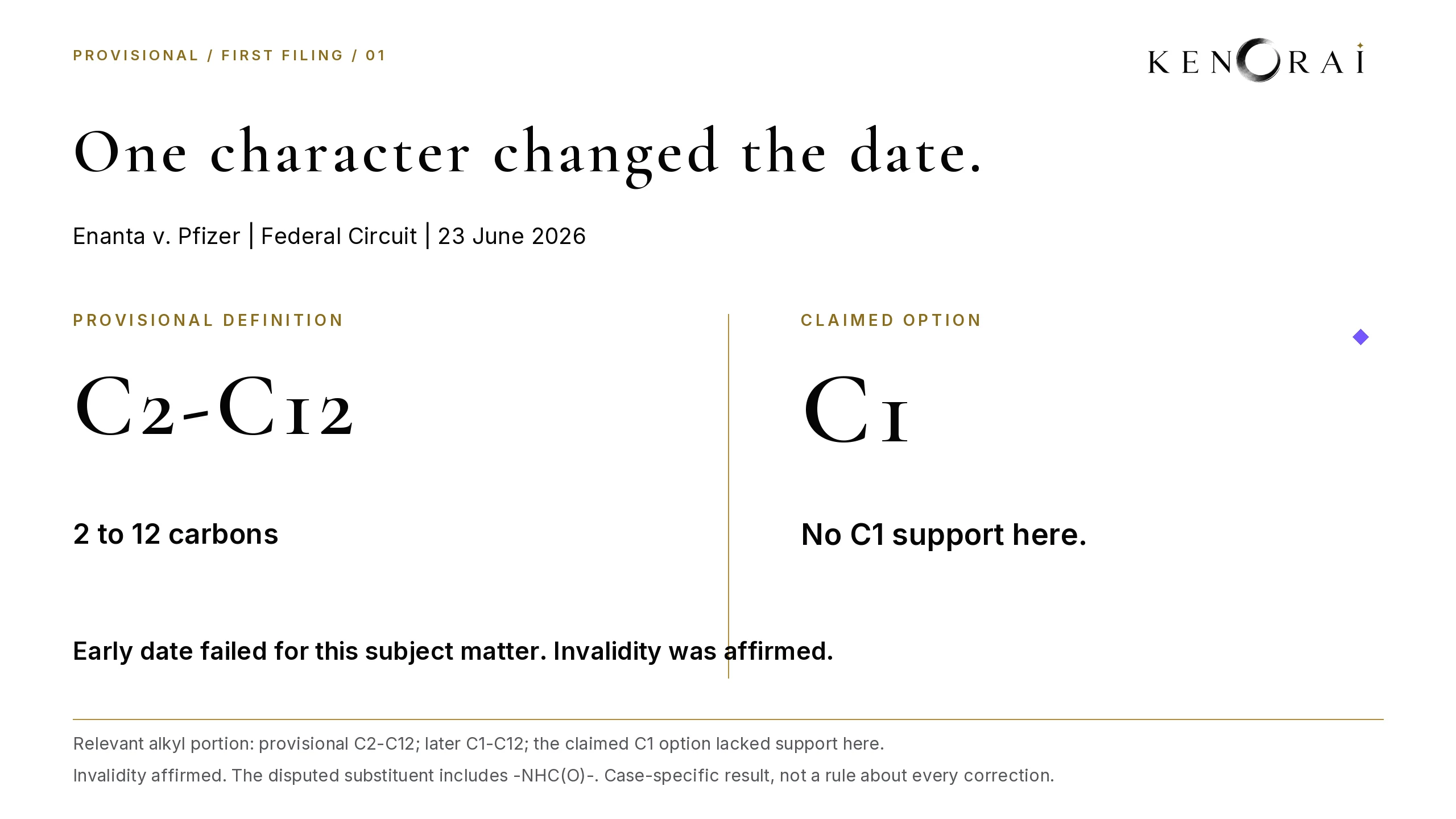
In June 2026 the US patent appeals court upheld a ruling that a patent was invalid because its first filing said C2 where the later claims needed C1.
The patent owner argued that any chemist reading the filing would recognize an obvious typing error and mentally correct it. The court declined to run that analysis. The question, it held, is whether the earlier filing shows you possessed what you later claimed. Not whether a mistake in it can be explained. The patent lost its early date, material published between the two filings counted against it, and the claims fell.
That case is Enanta Pharmaceuticals v. Pfizer, and one character in a chemical formula is the whole story.
The document nobody re-reads
Most founders treat a provisional as a timestamp. Get something on file, get a date, come back and do it properly within twelve months.
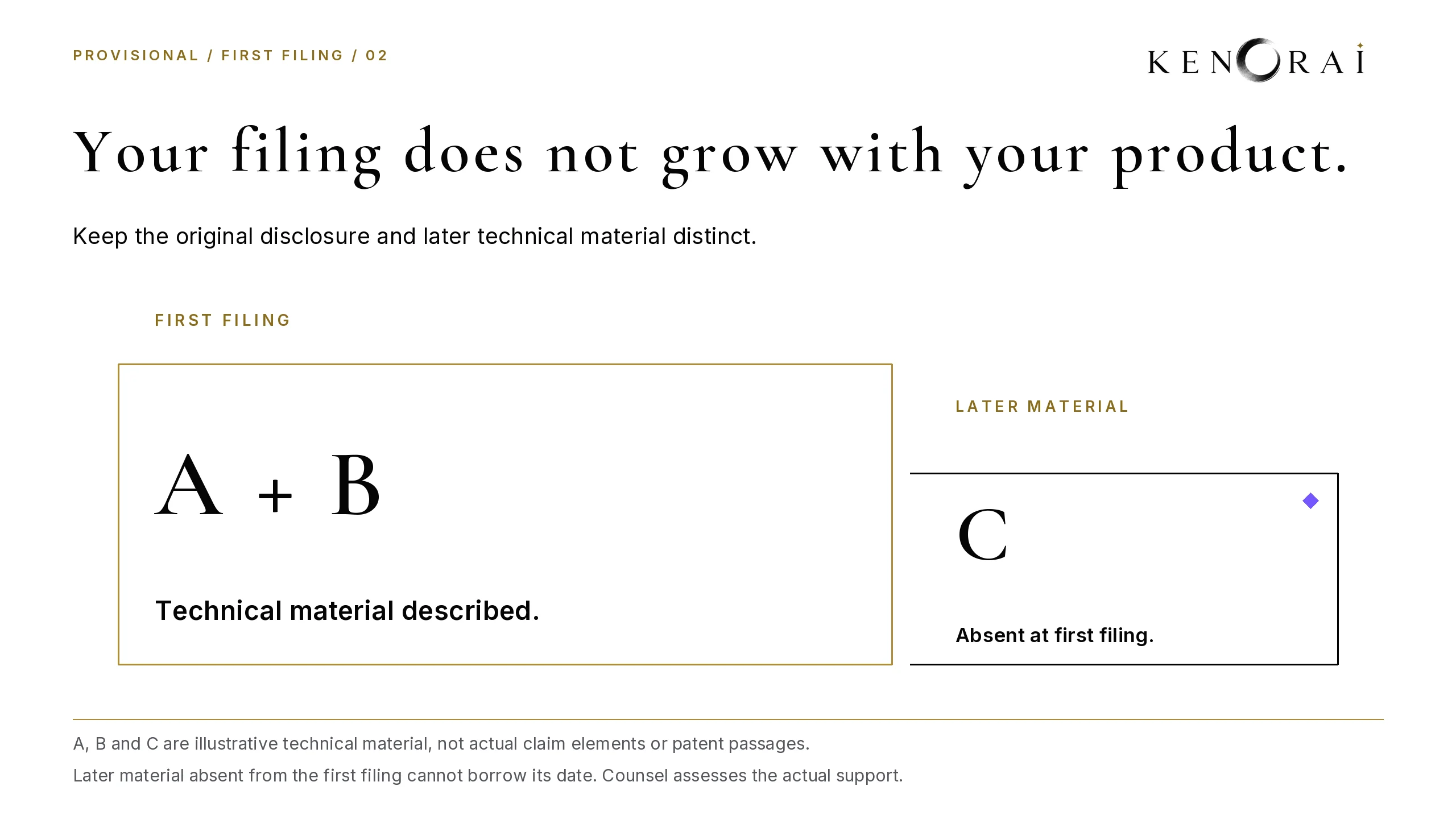
That instinct is half right. The provisional does secure a date. What it does not do is secure a date for anything you did not describe in it.
Think of a restaurant reservation. It holds a table for the number of seats you wrote down. Show up with eight people on a reservation for four and the extra four wait at the bar. A provisional holds a date for exactly what it describes. Everything you add later gets a later date. This has always been the rule. What 2026 added is a second direction in which the same rule now cuts.
Why this is getting worse, not better
Technical material is now produced faster than it is checked.
McKinsey's 2026 technology outlook names this as one of five themes across every field it tracks: AI generates output faster than organizations can absorb it. One study it cites found coding activity up 180 percent with AI coding agents in use, while shipped releases rose only 30 percent. In 30 percent of companies, productivity fell. The gap between what gets produced and what gets verified is widening.
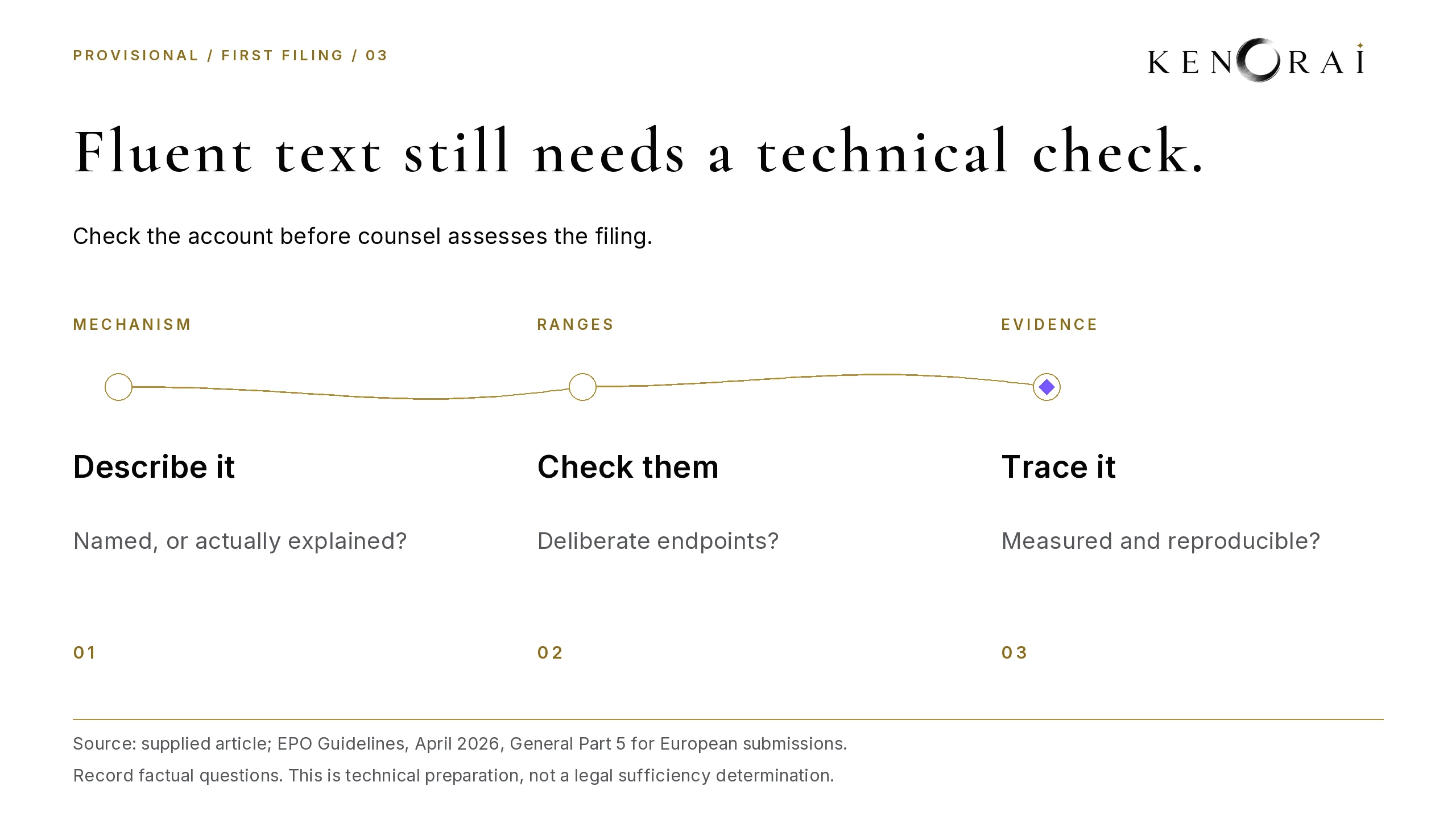
Provisionals live in that gap. A filing assembled in a week from an AI-drafted architecture document, a pitch deck and two paragraphs from an engineering wiki looks thorough. It reads fluently. Nobody has checked whether the ranges are the ones you meant or whether the mechanism is actually described rather than named. For European filings, the European Patent Office said as much in its April 2026 guidelines: applicants remain responsible for the correctness and completeness of what they file, however much AI helped draft it.
Direction one: it limits what you can claim
Enanta is the clean illustration. A deed that says lot 2 when you meant lot 1 conveys lot 2, however obvious the slip. A single definition drifted between the first filing and the full one, the early date failed for that subject matter, and material from the gap became usable against the patent.
The startup version is less dramatic and lands the same way. Twelve months after the quick provisional, the product has moved. The full application is drafted against what the company actually built, and it describes things the provisional never mentioned. Ranges that were not stated. Alternative designs that were not contemplated. A control mechanism that turned out to be the inventive part and was one clause in the original.
Nothing looks wrong. The patent issues. The defect sits quietly inside a granted patent until somebody has a reason to look, and the people with a reason to look are the ones you least want finding it.
Direction two: it decides what can be used against you
The same rule also decides what can be used against you, and in August it moved.
On August 10, 2026, in Dental Monitoring SAS v. Align Technology, the same appeals court threw out a decision that had found claims unpatentable on a method for analyzing dental images with a deep learning system. The decision had relied on a third party's published application whose date ran back to a provisional filed in late 2016. Whether that filing counted as "before" at all depended on whether it could borrow its provisional's date.
The patent office tribunal had said yes, under a procedural test it had been applying to current-law patents. The appeals court said that was the wrong test. To borrow the provisional's date, the earlier filer's provisional must itself contain proper written description for at least one claim of the later filing. Since nobody had checked, the decision was thrown out and sent back.
Go back to the restaurant. Someone else's reservation can be challenged on the same terms as yours. If their first filing did not describe what their later filing claims, their "earlier" date is not earlier. For patents under current law, the patent office had been treating that as a formality. It is now a factual question about the quality of somebody else's document.
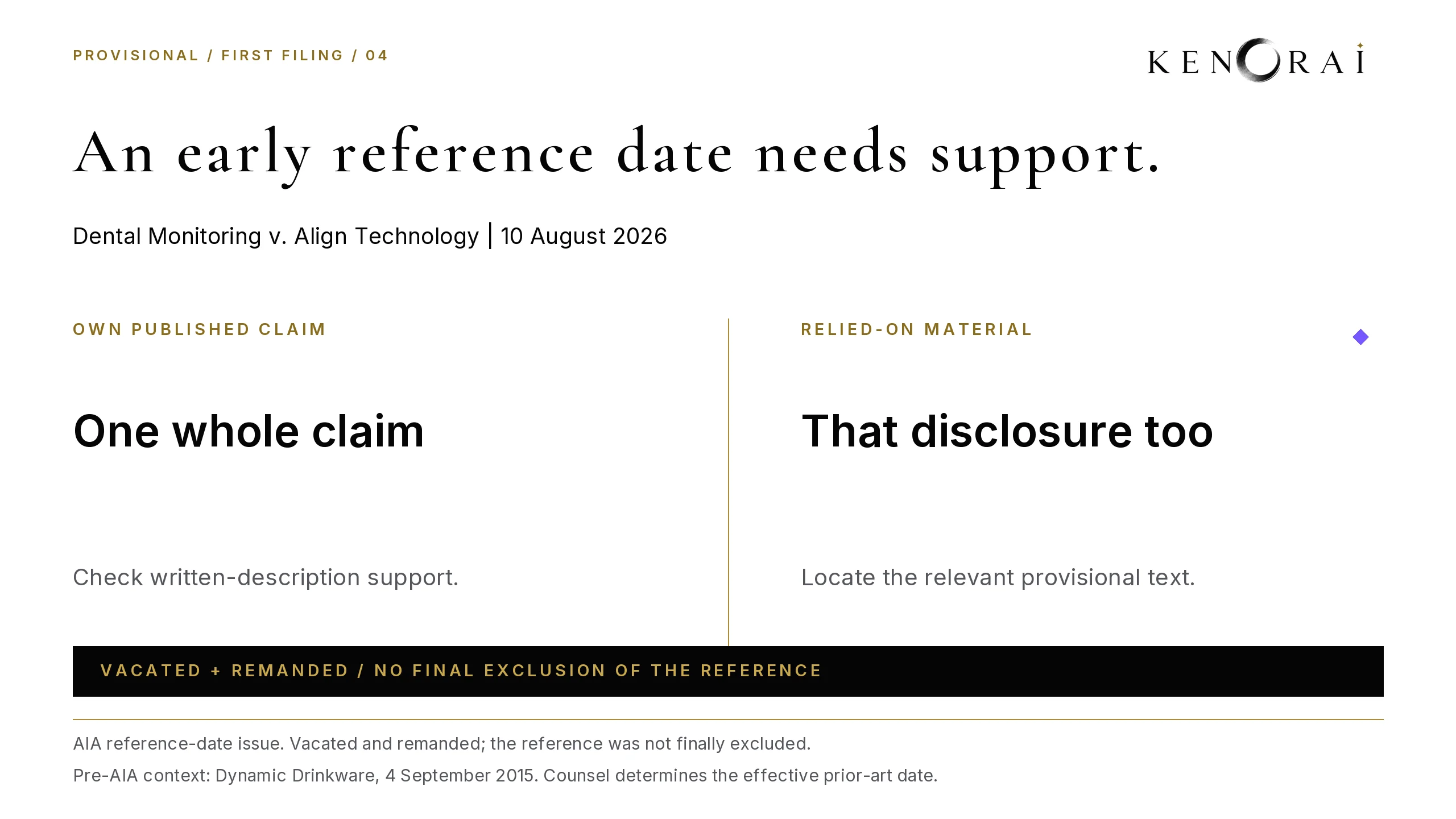
The same rule, pointed at two different documents
Both cases turn on one idea. A provisional is a written description document, and it is entitled to exactly as much as it describes.
Applied to your own filings, that is a discipline problem. Applied to the references sitting in your search results and attached to demand letters, it is an opening.
Any reference in a dispute that depends on a provisional date now has a point worth examining. Somebody has to read that provisional against the reference's own claims, element by element. Much of the work is technical, it is unglamorous, and for current-law patents the patent office had been saying it did not need doing.
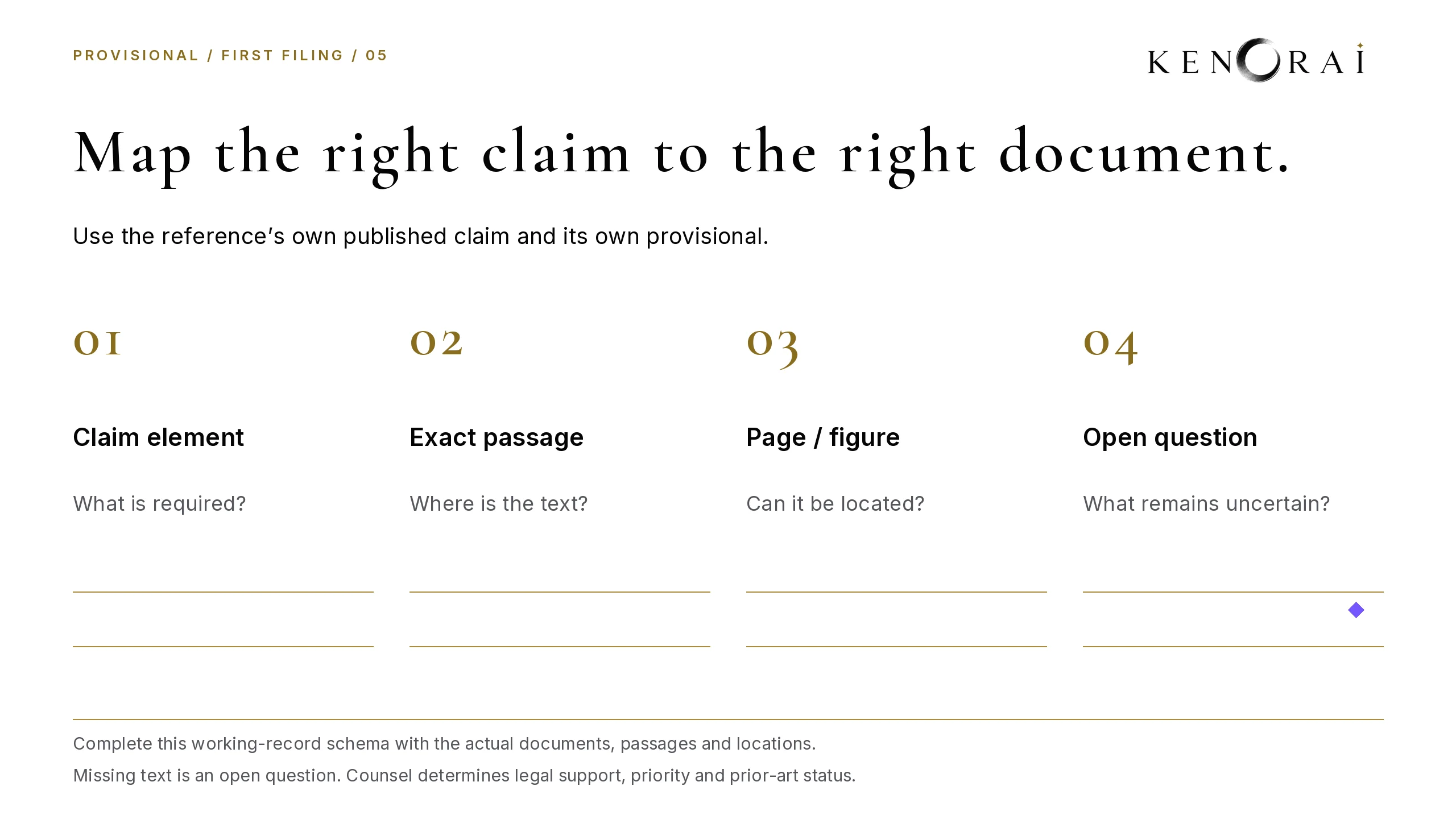
What a provisional has to actually contain
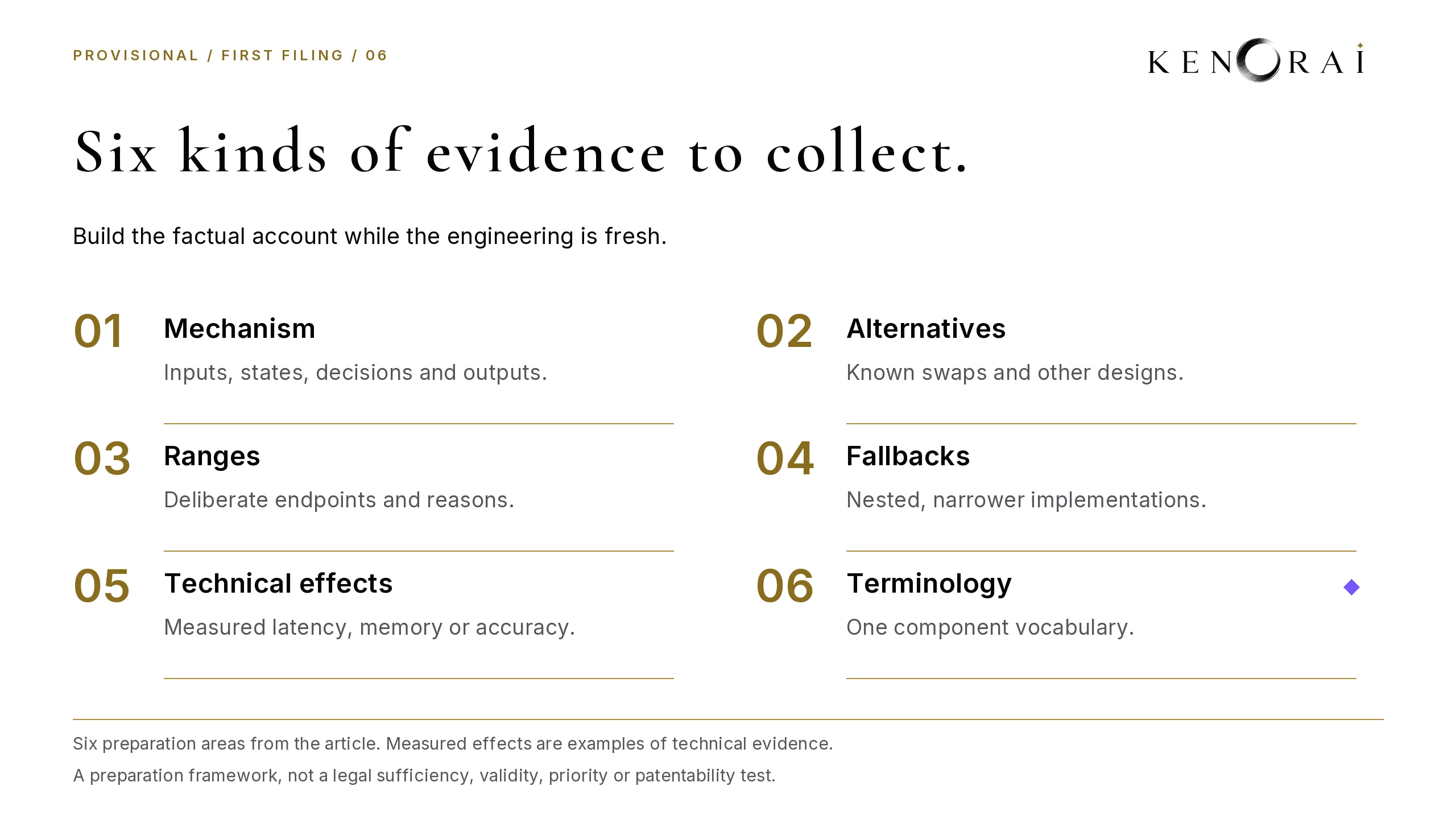
The test is not length. A short filing that describes the mechanism precisely beats forty pages of slides.
- The mechanism, not the outcome. What the system does differently: inputs, states, transformations, decisions, outputs. "Uses machine learning to improve scheduling" describes a result. Results are not support.
- The alternatives you already know about. If a competitor could swap one component and step outside your claims, the provisional should already contemplate the swap.
- Ranges and their endpoints, stated deliberately. Enanta is the warning. Whatever numbers appear should be the numbers you meant, checked by someone who understands them.
- Fallback positions. Narrower versions nested inside the broad one, so that if the examiner forces you to narrow, there is somewhere supported to go.
- The technical effect, with evidence. Benchmarks, latency, memory, accuracy, measured while the engineering is fresh and the person who ran the test still works there.
- Consistent terminology. One vocabulary for components and interfaces, used the same way throughout.
Common mistakes
- Filing the deck. A pitch deck describes what the product achieves for a customer. Support requires describing how the system works.
- Assuming detail can be added later. It can. It gets the later date. The gap is where other filings live.
- Trusting fluent AI-drafted text. Fluency is not completeness.
- Not re-reading the provisional when the full claims are drafted. The claims chase the product. The provisional does not move.
- Accepting a reference's early date at face value. After Dental Monitoring, it is a factual question, not a formality.
How Kenorai fits
Two pieces of this are technical work, and Kenorai does them.
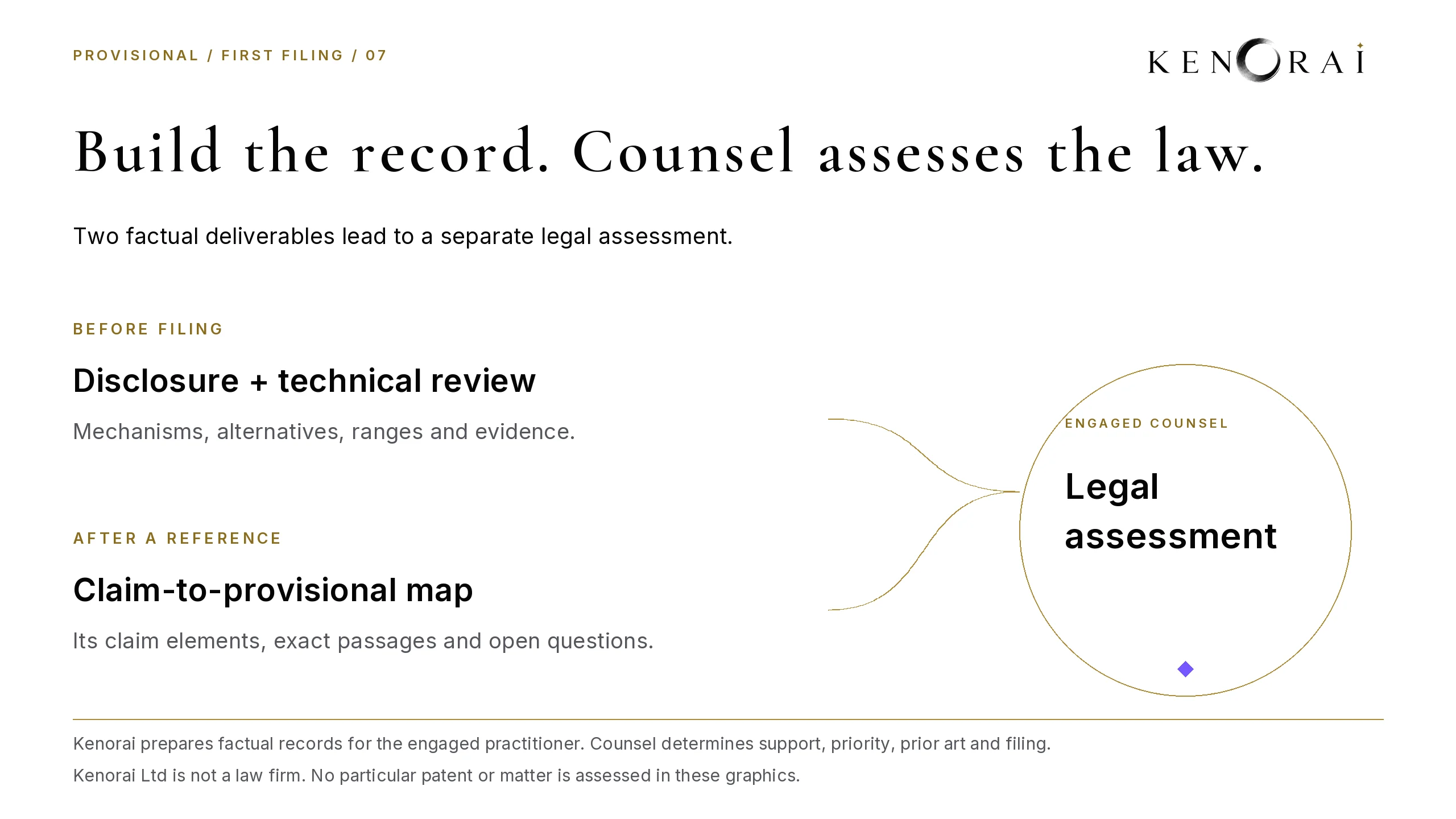
Before filing, a disclosure package built so counsel can assess priority support: mechanism-level description, the tree of alternative designs, deliberate ranges, nested fallback positions, a consistent technical vocabulary, and a technical-effect evidence file built while the engineering is still fresh. Then an adversarial technical review of it, flagging where a mechanism is named rather than described and where a range is asserted rather than measured, before counsel decides what to file and prosecute, meaning argue through the patent office.
After a reference shows up, in a search result or attached to a demand letter, the comparison work: pulling the reference's provisional, mapping it against the reference's own claims, and documenting which claim elements find corresponding text in the provisional and which do not, for counsel to assess.
Both outputs are factual records. Whether a priority claim is valid, whether a reference qualifies as prior art, whether a disclosure supports a claim, and what to file are legal determinations that belong to a registered patent attorney or agent engaged for your matter. Kenorai builds the evidence that determination gets made on.
The document you filed and forgot
Somewhere in your files there is a provisional written in a week, twelve to thirty-six months ago, that nobody has read since against your current claims.
That document is doing more work than you assigned it. It sets the outer edge of what your patent can reach, and after this summer, the same standard sets the outer edge of what someone else's filing can reach at you.
Pull it up. Read it against what you actually built.
What does it describe that your claims need, and what does it not?
This article reports public developments in decided cases. It is not legal advice and is not an opinion on the validity, priority, or scope of any patent, application, or matter. Questions about a specific portfolio belong with your own counsel.
Kenorai Ltd is not a law firm and nothing here is legal advice.
Sources
- Dental Monitoring SAS v. Align Technology, Inc., No. 2025-1752 (Fed. Cir. Aug. 10, 2026).
- Enanta Pharmaceuticals, Inc. v. Pfizer Inc., No. 25-1427 (Fed. Cir. June 23, 2026).
- Dynamic Drinkware, LLC v. National Graphics, Inc. (Fed. Cir. 2015).
- McKinsey & Company, Technology Trends Outlook 2026, September 2026 (cross-cutting theme 2; agentic software development productivity figures).
- EPO Guidelines for Examination, 2026 edition.


No comments yet