
Picture the first meeting.
Your company closed a round six weeks ago. At the second board meeting someone asked about intellectual property, so now there's a video call with a registered patent practitioner on the calendar (a patent attorney or patent agent licensed to practice before the US Patent and Trademark Office, the USPTO). Forty-five minutes, 10 a.m.
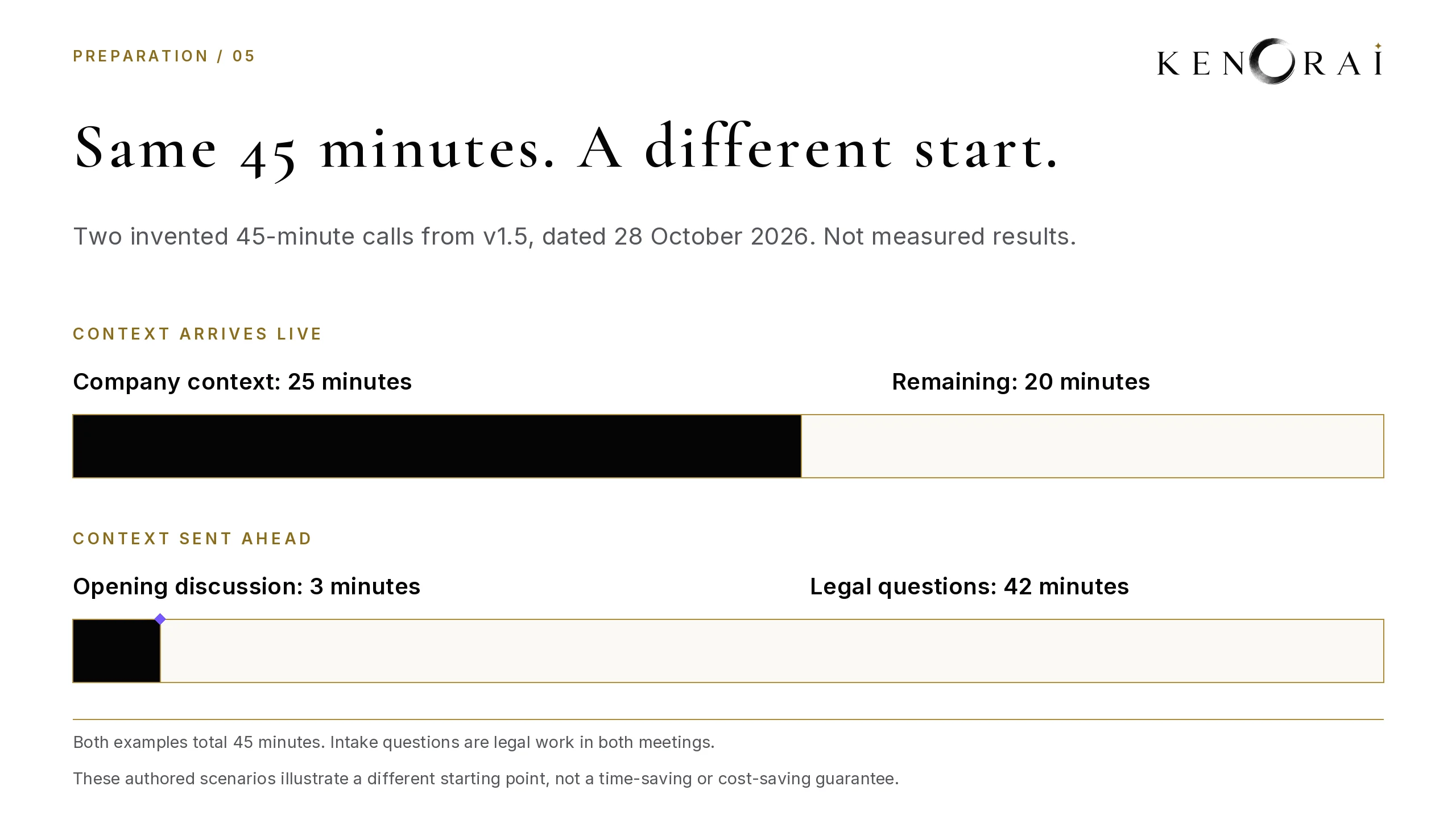
You and your CTO spend the first twenty-five of them explaining what the company does, who the competitors are, which product the technology sits in, and why any of it matters commercially. The practitioner takes careful notes and asks good questions. At some point you share a slide from the Series A deck with the word "moat" on it.
Everybody on the call is doing their job. The practitioner needs every bit of that context, and their questions are real legal work. The only question is whether the context arrived two days early as four pages, or live at 10 a.m. with the meter on.
That scene is invented. The pattern is one we hear about often enough to write this.
Why this matters now
Funded deep tech teams rarely have an in-house IP function. In the first 90 days after a raise, the same two or three people are hiring, shipping, reporting to a new board and answering investor questions about defensibility. IP lands on that pile.
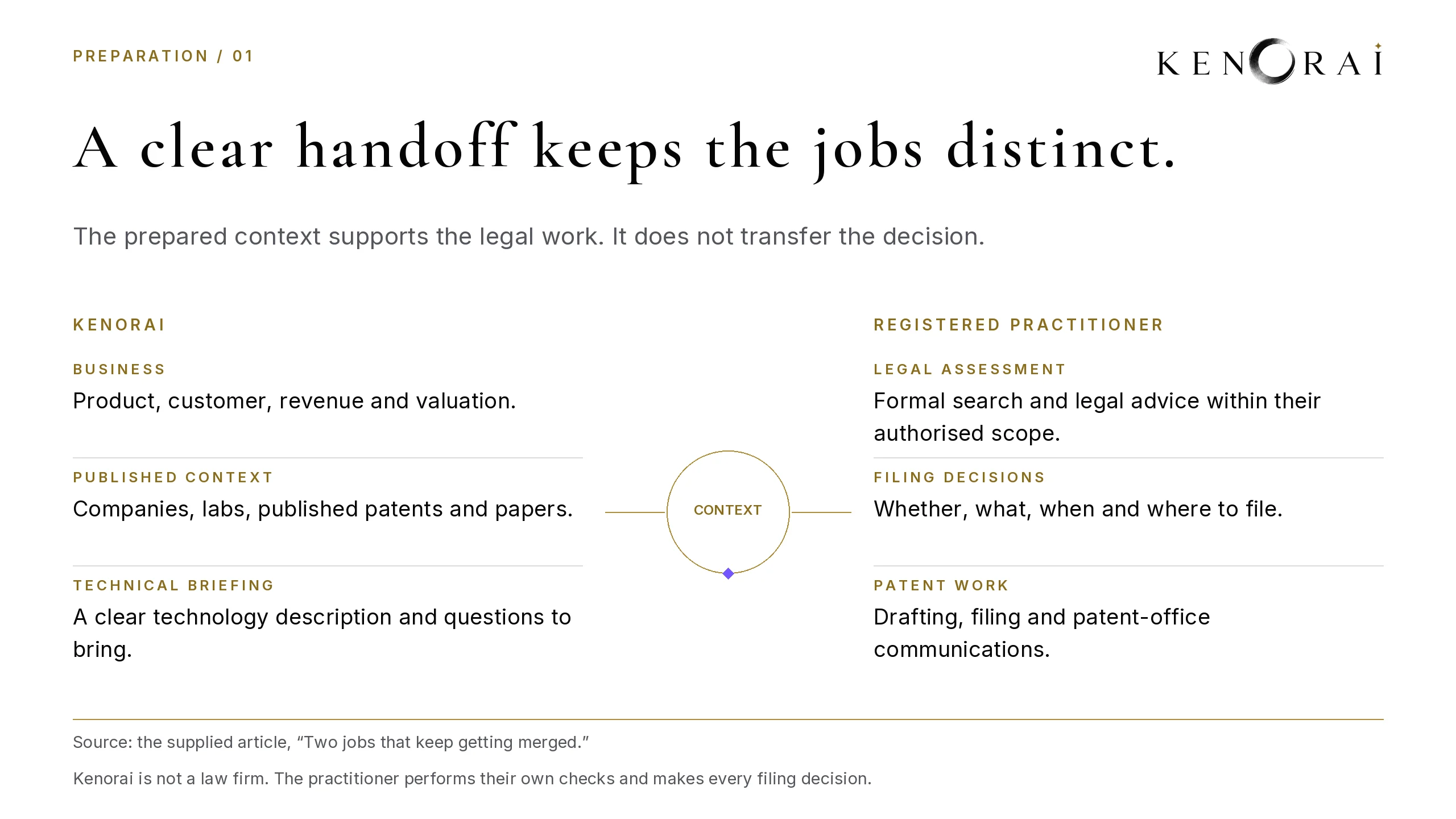
When it does, two different jobs tend to get merged into one meeting. One job is understanding the business: the market, the published landscape, the competitors, and how the technology ties to revenue and valuation. The other job is legal: the formal search, the drafting, the filing, and every decision about whether, what, when and where to file.
The second job belongs to a registered practitioner. The first job is where, in our read rather than any statistic, most founders arrive empty-handed.
It's like paying movers by the hour and spending the first hour packing in front of them. The movers still have the real job ahead of them. The packing could have been done the night before.
The core idea
The legal work goes best when the business questions are answered before it starts, by someone who has no stake in what gets filed.
That sentence is the reason Kenorai exists.
Two jobs that keep getting merged
Kenorai is a consulting firm. We advise founders on the business and technical side of their intellectual property: who else is working in their space, what the published landscape looks like, how their technology ties to revenue and valuation, and which questions to bring to a practitioner.
We do not file. We do not give legal opinions. We do not decide what is worth filing. Those decisions sit with a registered practitioner, every time.
Think of a map and a pilot. The map shows where the mountains are and where the weather is building. Only the pilot decides whether to fly, and when, and by which route. A good pilot reads the map closely and runs their own checks of it, which is what the formal search is, so the metaphor only goes so far. But the business picture shouldn't be drawn for the first time on the clock.
A consultant can show you where you stand in the market. Only a registered practitioner can tell you what to do about it legally.
What preparation actually looks like
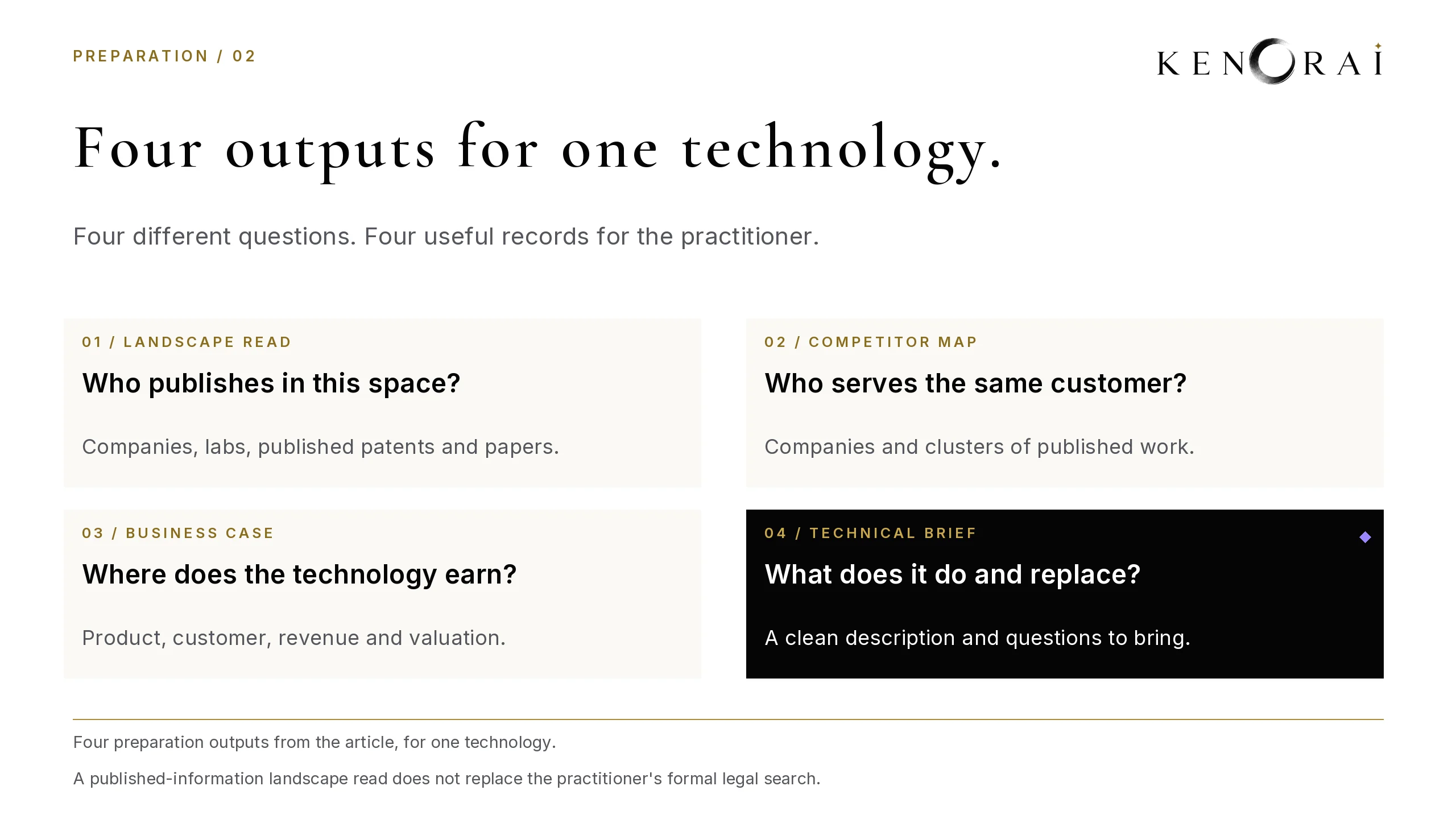
Preparation is concrete. For a single technology, it usually means four things. Call it the packing list.
A landscape read: who else publishes in this space, including companies, labs, and the patents and papers already in the public record.
A competitor map: which companies are building toward the same customer, and where their published work clusters.
A business case: which product the technology sits in, which customer pays for it, and how it shows up in revenue and valuation. We red-team this before money goes into legal work, because an investor will red-team it later anyway, less gently.
A technical briefing pack for the practitioner: a clean description of the technology, written so nobody has to explain it twice.
Why the money has to stay separate
Advice tends to lean toward how the advisor gets paid. That is ordinary, and it is why we set our rules before we signed anything.
Ask a sommelier what to drink and you'll get a good answer. Ask whether they're paid by the bottle and you'll get a better one.
To be clear about who this is aimed at: a practitioner is paid for legal work, and that is proper and disclosed up front. The question is for everyone whose advice comes before the legal work, including us.
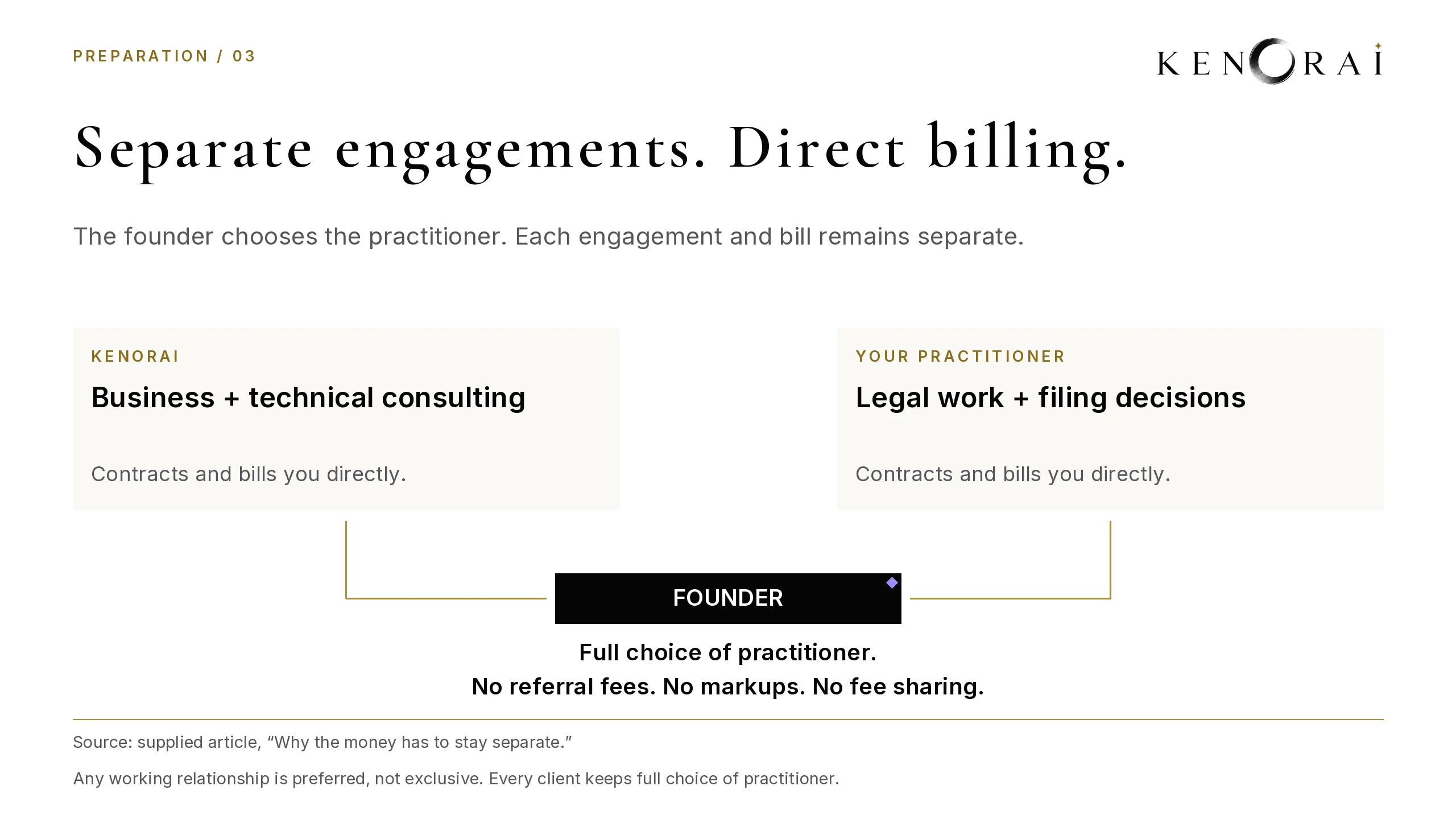
Kenorai does not file and takes no referral fee, so our advice has no stake in how much you file. Each firm a founder works with contracts and bills the founder directly. No referral fees, no markups, no fee sharing in either direction. Any working relationship we have with a practitioner is preferred, not exclusive, and every client keeps full choice of practitioner.
Founders should ask this question of every advisor around their IP, including us: how do you get paid, and does that change if I file more, file less, or file nothing? The answer should take one sentence. If it takes a paragraph, that's an answer too.
Ask every advisor how they get paid. It should be a one-sentence answer.
A practical prep list before your first practitioner meeting
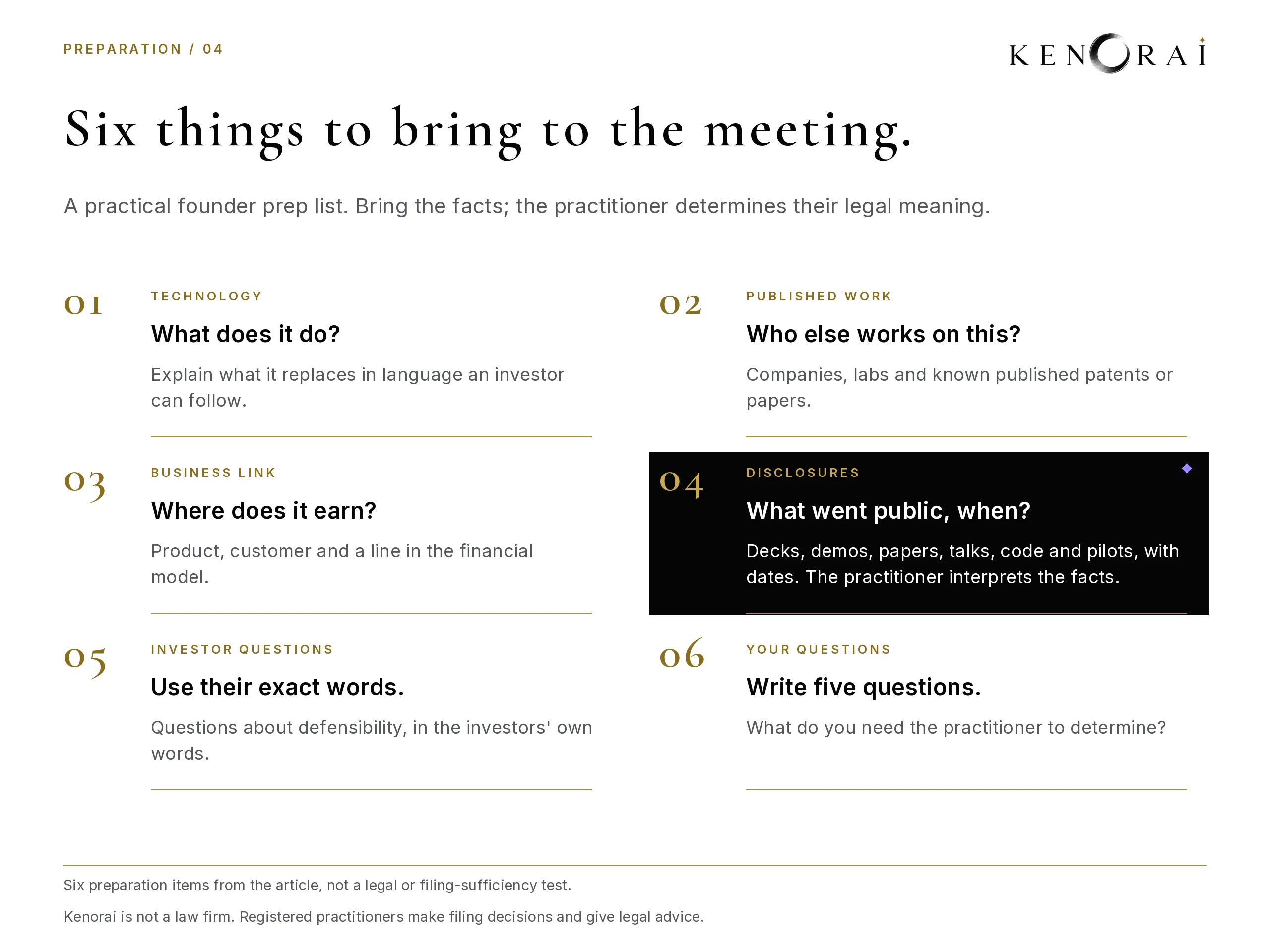
None of this replaces the practitioner. It gets you ready for them. The four items above are what a consultant like us builds. The six below you can do yourself this week, with or without us.
- One page on what the technology does and what it replaces, written for an investor rather than an engineer.
- A list of who else is working on this: companies, labs, and any published patents or papers you already know about.
- A line from the technology to the money: which product, which customer, which line in your financial model.
- A dated list of everything you have shown outside the company: decks, demos, papers, talks, open code, customer pilots. Bring it to the practitioner. They will tell you what it means.
- Your investors' questions about defensibility, written down in their words.
- Your own questions for the practitioner. If you cannot write five, that is where to start.
Common mistakes
Using the first billed hour as a briefing. Context the practitioner needs is context you can prepare. Prepared context frees the meeting for legal questions.
Asking a consultant the legal question. "Should I file on this?" and "Is this patentable?" belong to a registered practitioner. A consultant who answers them is outside their lane, and that includes us.
Keeping the IP story apart from the investor story. Investors ask why the technology is hard to copy. If the board deck and the practitioner meeting give different answers, someone will notice, and it will be the person you least want noticing.
Not asking how advisors are paid. It is a normal question, and a clear answer is a good sign.
Building the story for the first time in investor due diligence. By then you are assembling it under deadline, for someone else's checklist, at the exact moment your calendar has no room for it.
The second version of the meeting
Picture the same call, one change. Two days before, you sent the one-pager, the competitor list and the dated list of what you've shown outside the company. At minute three, the practitioner asks a question about one line on that list, and it's a question you couldn't have answered on your own, which is the whole point of having them on the call.
Forty-two of the forty-five minutes go to legal questions. Nobody explained the company twice. The moat slide stayed in the deck. That scene is invented too, and it's the one we're aiming for.
Where this leaves a founder
The legal work is the practitioner's. The business picture is yours to bring, and you can prepare it before the first meeting starts. Bring the picture. Let the meeting start at the hard part.
Our aim is founders who arrive at the practitioner prepared, so the legal work starts from a clear picture. That is an aim, not a promise.
If you closed a round this year and want hard questions asked about your IP story before you spend on it, start with a conversation: kenorai.com/contact
Kenorai is not a law firm. No Kenorai personnel are licensed attorneys or registered patent agents. We do not practice law, do not practice before the USPTO, do not give legal opinions, and do not make filing or claim decisions. We provide technical and business consulting that helps companies prepare for their work with a licensed practitioner. Licensed practitioners are engaged for each matter, and they make every filing decision and give all legal advice.

No comments yet