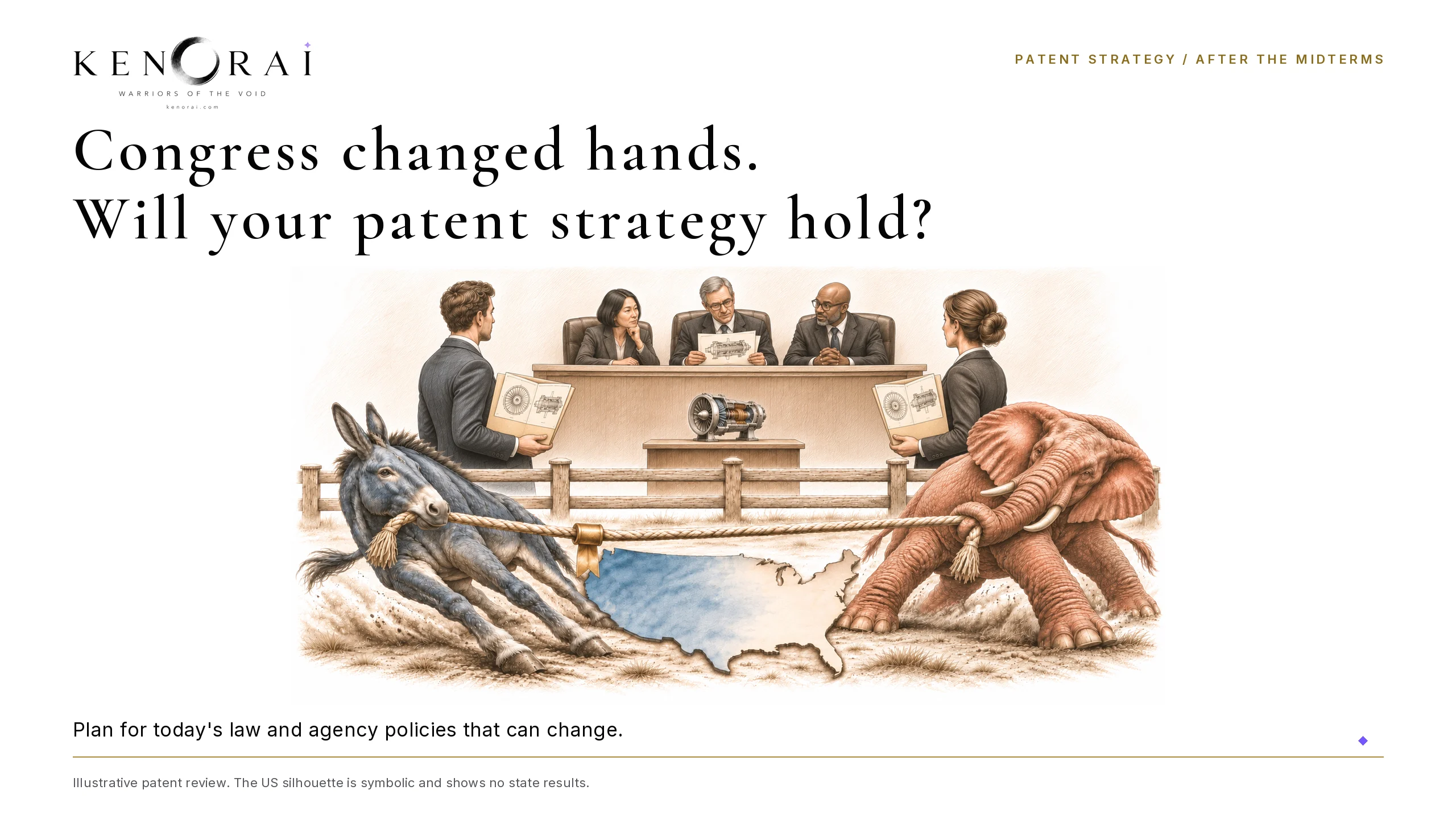
Control of Congress moves in January. The rules that decide how durable your next patent will be were set inside the patent office, and an appeals court has said the office can change them on its own.
Picture this morning. You run a deep tech company, and your patent counsel wants a decision by Friday on which of three positions to file. Your phone has buzzed since Tuesday night with maps turning blue. You scroll the coverage looking for the line that tells you whether to wait. It isn't there.
Election nights make it feel like everything changed at once. For a founder deciding what to file this quarter, most of what matters didn't.
By Wednesday afternoon, ABC, CBS, NBC and CNN all projected that Democrats will control both the House and the Senate when the new Congress is seated in January, with a few Senate races still uncalled. For patents the answer splits in two. The people who write patent law are about to change. The people who apply it every day are staying put.
Here is why that matters to you. A patent is a 20-year asset, and the money you spend on it goes out in the first two years: drafting, filing, and the back and forth with the examiner. Whether that money comes back depends on rules that are all in motion at once. What kinds of inventions can be patented at all. Whether a granted patent survives when a competitor asks the patent office to cancel it. What the office charges and whether it can keep setting its own fees. The election decided who writes the law on each of those questions for the next two years. It did not decide what the patent office will do between now and then, and the positions you file this quarter will live under both sets of rules. If a patent you raised money on turns out to depend on a policy that gets reversed, the cost lands on you, not on whoever reversed it.
The patent bench was turning over anyway
The Senate's patent leadership was changing no matter who won. Thom Tillis, who chairs the Judiciary subcommittee on intellectual property and is the lead Senate sponsor of eligibility reform, said in June 2025 that he would not run again. Dick Durbin, the committee's top Democrat and a cosponsor of one of the two main reform bills, retires in January. Chuck Grassley, the committee chair, was already set to give up the gavel under his party's term limits.
What Tuesday settled is which party picks the new chairs in both chambers, and so which bills get a hearing in 2027.
Two reform bills are running out of road
Two bills have framed the patent debate in this Congress. The Patent Eligibility Restoration Act, known as PERA, would rewrite the rules on what kinds of inventions can be patented at all, replacing court-made exceptions that have been used to reject or invalidate many software and AI patents. The PREVAIL Act would make it harder to challenge a granted patent at the Patent Trial and Appeal Board, the patent office's own tribunal for reviewing patents after they issue.
Supporters say both bills would restore certainty for inventors and investors. Critics, including some consumer and drug pricing groups, say they would make weak patents easier to get and harder to fight.
Both were introduced in May 2025. As of October, neither had been reported out of committee. PERA got its first full Judiciary Committee hearing in July. Bills still pending when this Congress ends on January 3 expire. Their sponsors start over.
That leaves the lame duck, the weeks between an election and the new Congress. An earlier version of PREVAIL cleared committee 11 to 10 in late 2024 and still stalled. A December vote is possible. We would not build a filing plan around one.
The one hard date
The deadline that matters is mid-December. The patent office's authority to set its own fees was due to expire September 16. Congress extended it only to mid-December, in the same stopgap bill that funds the government until then.
At a September House hearing, the IP subcommittee chair suggested Congress could decline a longer extension unless the office showed it was fully carrying out the America Invents Act, the 2011 law that created the PTAB. The PTAB is the Patent Trial and Appeal Board, a panel of administrative judges inside the patent office. It hears appeals from rejected applications, and it hears requests from outsiders, usually competitors, to cancel patents the office has already granted. Some witnesses asked for limits on how the office turns away patent challenges as a condition of renewal. The subcommittee's ranking Democrat argued that tying the two together would make a routine renewal controversial. The logic runs like this. The patent office runs on the fees it collects, not on tax money, and renewing its power to set those fees has usually passed with little debate because both parties want the office funded. How the PTAB should handle challenges is a live fight, with inventors and operating companies on one side and challengers and some consumer groups on the other. Attach that fight to the renewal and every member who disagrees about the PTAB now has a reason to hold up or vote against a bill they would otherwise wave through. A routine funding item becomes a bargaining table, and the risk is that the authority lapses while the two sides argue.
So the fee question is the one patent item with a hard deadline this year, and some members see it as a bargaining chip over how the office runs the PTAB.
What the election didn't touch
The rules shaping how durable a new patent is today did not come from Congress. Since late 2025 the patent office director has personally decided which challenges to issued patents the PTAB will hear. The office has added reasons to turn challenges away, including how long a patent has been in force and whether the challenged products are made in the United States. A proposed rule that would put some of this into regulation now sits with the White House budget office for review.
The agency's own records show what that looks like in practice. The most common challenge is an inter partes review. The Latin means "between the parties," and it works like a short trial inside the patent office. A challenger, usually a competitor or a company that has been sued, files a petition arguing that the patent should never have been granted because earlier patents or publications already described the invention. The patent owner responds. If the office agrees to hear the case, a panel of PTAB judges decides whether to cancel the claims. It is faster and cheaper than fighting the same question in federal court, which is why challengers use it. As of this week, the USPTO's PTAB data lists 1,367 of these petitions in its 2025 series. It records 590 of them, or 43 percent, as discretionary denials, meaning the office declined to hear them for reasons other than the merits. The 2026 series lists 420 petitions, about a third as many.
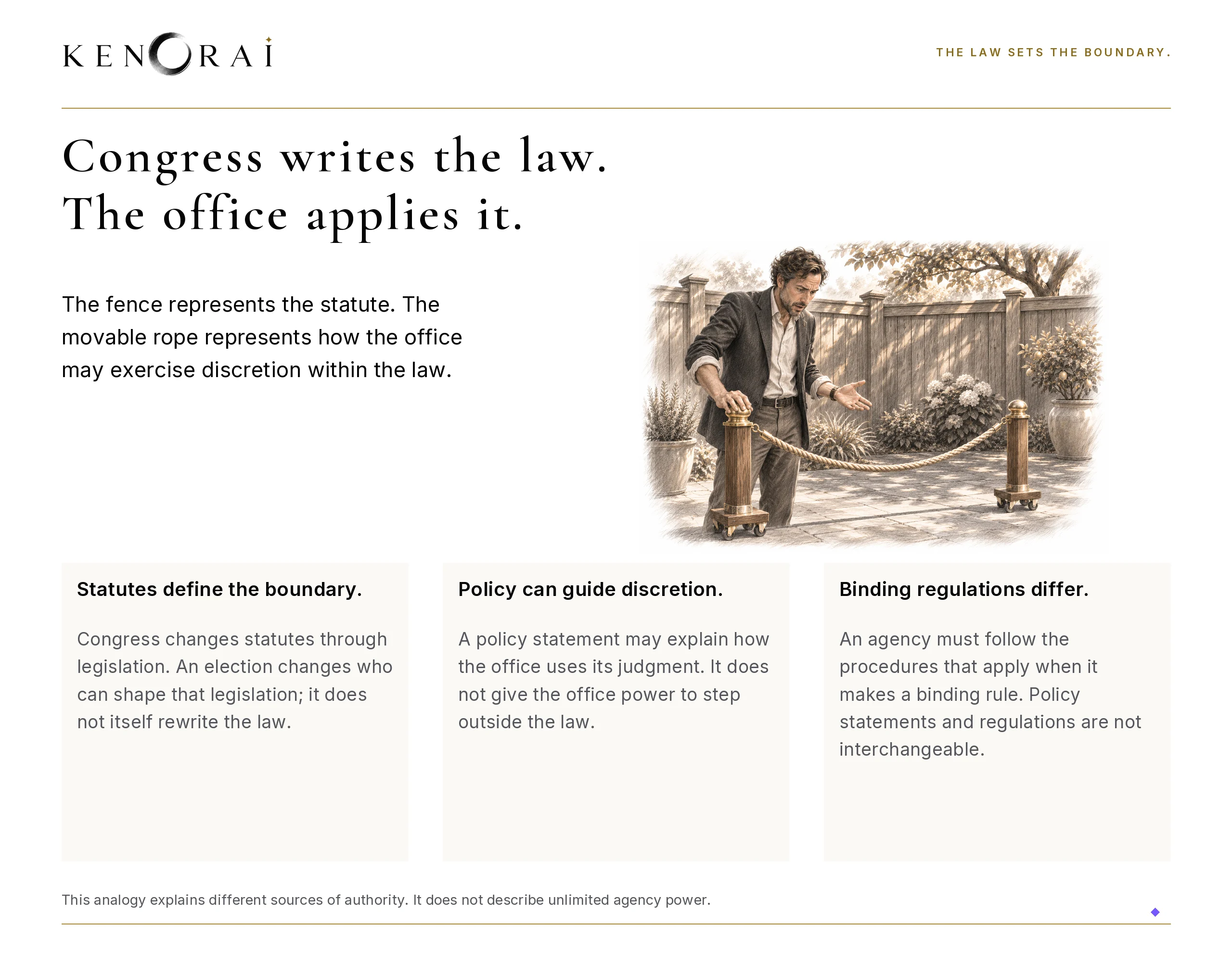
Think of the difference between a fence and a rope. A statute is a fence line: Congress surveys it in public, and moving it takes a vote. The director's guidance is a rope the office strung across its own yard, and the office can move the rope. In February the Federal Circuit, the appeals court for patent cases, said as much. It held that the guidance is a general policy statement rather than a binding rule, which is why it needed no public comment period. The office can change course, in the court's words, "even abruptly." The comparison stops at the yard's edge. A court can still check whether the rope stayed inside the fence, and turning a rope into a fence takes a public rule-making process, which is where the proposed rule now sits.
Current policy makes an issued patent harder to challenge at the patent office. That helps if the patent is yours and hurts if someone else's sits across your roadmap. The new Congress could write parts of it into law or bargain it away in a fee bill. A new administration takes office in 2029.
What this means for a portfolio you're building now
Investors price patents partly on how long they'll stand. A position whose value depends on today's policy is worth less in diligence than one that holds under any reasonable version of the rules. Three things follow.
First, eligibility law hasn't moved. Until Congress acts, the court-made tests still apply to applied AI and to the software layers inside robotics, energy and edge hardware. The USPTO granted more than 14,000 patents in 2025 that carry an artificial intelligence classification, and every one of them was examined under those tests. Ask your practitioner how the tests read on your positions before drafting starts, not after the first rejection.
Second, don't count on today's review posture. Plan as if any future challenge to your patent gets heard on the merits. If a position would only survive because review was denied, find out now and decide with counsel whether to strengthen it.
Third, watch the fee clock. If fee authority lapses or changes shape in December, fee timing on pending matters could shift. Ask your practitioner whether anything on your docket is exposed.

For investors and board members
For each advantage a company's plan depends on, ask three things. Did we decide on purpose whether to patent it, keep it secret, or rely on speed? Who owns that decision? Did anything go public before we decided?

Any of those choices can be right. Drifting is the expensive one. It's how a company ends up with a public demo, no filing, and a competitor who read the press release.
How Kenorai fits
Before anyone spends on drafting, we build the technical record for each candidate position: what the invention does, how it differs from what is already public, and the questions your practitioner will need answered under the rules in force today and the ones most likely to replace them. You take that record, in plain language, to the registered patent attorney or agent you choose, and they make every filing and claim decision.

We don't give opinions on patentability, validity, infringement, freedom to operate, or inventor-ship, and we don't draft or file. We earn nothing from filings and take no referral fees.
What this changes
Elections set the direction of patent policy over years. Your filing calendar runs in quarters.
Build for the rules you can read today, and for the ones that could replace them by memo.
This week, list the positions your next raise depends on and mark each one: would it still stand if the patent office reversed course next year?
Book a conversation at kenorai.com/contact. Through November 11, 2026, founders can also request a free consultation and an initial white-space analysis of one invention.
Jan Gerards is Managing Partner and co-founder of Kenorai and a named co-inventor on seven granted US patents.
About Kenorai
Kenorai is a patent strategy consultancy for deep tech companies, Founded by Jan Gerards, Managing Partner, and Seth Everson, Co-Founder and Principal Technical Partner.
We work alongside any patent attorney or agent you choose. In certain technology areas, we also have a working relationship with a preferred patent agent we can bring in when it fits. That relationship is non-exclusive, and we receive no referral fees or other compensation from any patent agent or firm.
Kenorai is not a law firm. No Kenorai personnel are licensed attorneys or registered patent agents. We do not practice law, do not practice before the USPTO, do not give legal opinions, and do not make filing or claim decisions. We provide technical and business consulting that helps companies prepare for their work with a licensed practitioner. Licensed practitioners are engaged for each matter, and they make every filing decision and give all legal advice.
This article reports public developments and is not an opinion on any patent, application, or matter. Kenorai Ltd is not a law firm and nothing here is legal advice.
Sources
ABC News, "2026 midterm elections: Democrats projected to gain control of House and Senate," Nov 4, 2026. https://abcnews.com/Politics/balance-power-congress-stake-2026-midterm-elections/story?id=137777679
CBS News, midterm election live updates, Nov 4, 2026. https://www.cbsnews.com/live-updates/election-day-2026-midterms/
NBC News, midterm election live blog, Nov 4, 2026. https://www.nbcnews.com/politics/2026-election/live-blog/midterm-election-results-2026-news-trump-live-updates-rcna605763
CNN, midterm election live coverage, Nov 4, 2026. https://www.cnn.com/2026/11/03/politics/live-news/midterm-election-congress
USPTO, PTAB Trial data via the Open Data Portal, queried Nov 4, 2026. https://data.uspto.gov
USPTO, Patent Public Search, queried Nov 4, 2026. https://ppubs.uspto.gov
Apple Inc. v. Squires, No. 24-1864 (Fed. Cir. Feb. 13, 2026) (precedential).
Ballotpedia, Sen. Thom Tillis will not seek re-election, June 29, 2025. https://news.ballotpedia.org/?p=42302
Courthouse News, Dick Durbin to retire at the end of his term, April 2025. https://www.courthousenews.com/dick-durbin-no-2-senate-democrat-to-retire-at-the-end-of-his-term/
Axios Hill Leaders, Senate Judiciary leadership after Durbin's retirement, April 2025. https://www.axios.com/newsletters/axios-hill-leaders-a781e820-2070-11f0-864d-1d6dfd8961a5
Congress.gov, S.1553, PREVAIL Act, 119th Congress. https://www.congress.gov/bill/119th-congress/senate-bill/1553
Intellectual Property Owners Association, 119th Congress IP Legislation Overview, Oct 1, 2026. https://ipo.org/wp-content/uploads/2026/10/IPO-Legislative-Tracker-Oct-1-20206.pdf
A&O Shearman, PERA after the Senate Judiciary Committee's first full-committee hearing, Aug 4, 2026. https://www.lit-ip.aoshearman.com/the-patent-eligibility-restoration-act-emwhere-things-stand-after-the-senate-judiciary-committees-first-full-committee-hearingem
EFF, update on the Nov 21, 2024 Senate Judiciary Committee vote on PREVAIL. https://www.eff.org/deeplinks/2024/11/tell-congress-stop-these-last-minute-bills-help-patent-trolls
AIPLA, letter urging extension of USPTO fee-setting authority, Sept 2, 2026. https://www.aipla.org/detail/news/2026/09/02/aipla-joins-ipo-and-inta-in-urging-extension-of-uspto-fee-setting-authority
IPWatchdog, Issa hesitant to renew USPTO fee-setting authority amid PTAB changes, Sept 2, 2026. https://ipwatchdog.com/2026/09/02/issa-hesitant-to-renew-uspto-fee-setting-authority-amid-ptab-changes/
Legis1, Patent office faces December deadline in reform debate, Sept 2026. https://legis1.com/news/uspto-fee-authority-faces-december-deadline-amid
IPWatchdog, Senate IP subcommittee USPTO oversight hearing, Sept 29, 2026. https://ipwatchdog.com/2026/09/29/senate-ip-subcommittee-focuses-on-fee-setting-ptab-rule-in-uspto-oversight-hearing/
Brownstein, USPTO's new PTAB discretion policy and U.S.-manufactured IP, March 2026. https://www.bhfs.com/insight/usptos-new-ptab-discretion-policy-marks-a-major-shift-for-u-s-manufactured-ip/
PTAB Litigation Blog, USPTO designates new precedents on discretionary denial, Jan 21, 2026. https://www.ptablitigationblog.com/uspto-designates-new-precedents-on-ptab-discretionary-denial/


No comments yet