Three terms, in plain words
Eligibility: the rule about what can be patented at all. Abstract ideas and plain math can't be. A specific technical improvement to how a machine works can. For AI, this rule decides almost everything.
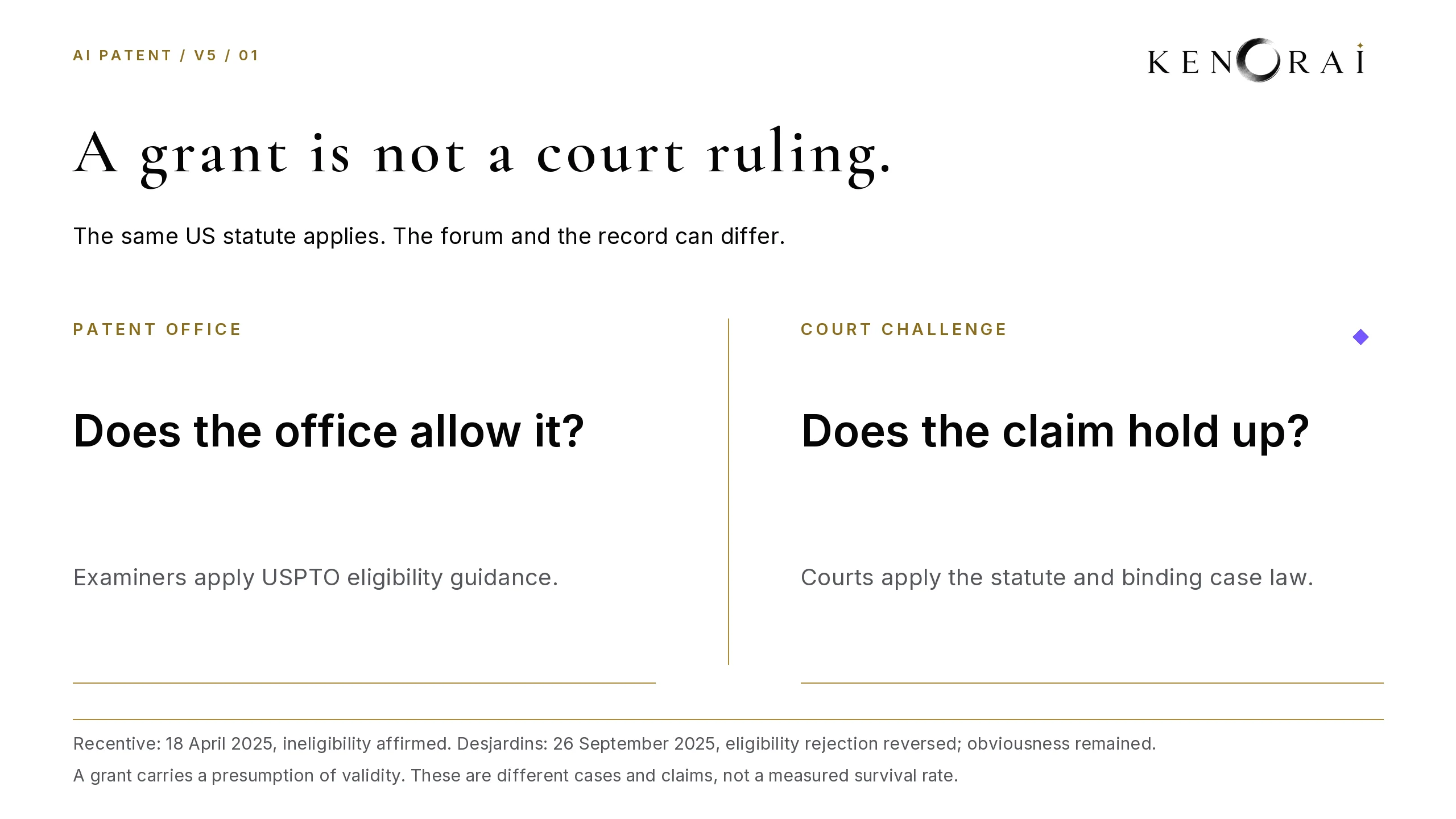
Granted versus holds up: the patent office grants a patent after examining it under its own guidance. A court looks later, applies the same law, and isn't bound by that guidance. The two can disagree.
Claim: the numbered sentences at the end of a patent that say exactly what's protected. Think of them as the fence line. Everything else is description.
Picture the email. Subject line: "Notice of Allowance." You don't know what that means yet, so you forward it to your cofounder, who does, and who replies in all caps.
Somebody orders a cake. Somebody renames the Slack channel from #patent-pending to #patented, which gets a bigger laugh than it deserves. The framed certificate goes up behind reception, at the exact height where an investor's eyes land. For about a year, that frame does its job.
Fourteen months later a competitor ships something that looks a lot like your product. Your lawyer files suit. Theirs answers with a short document asking the judge to throw the case out before it starts. Its first sentence says your patent covers "an abstract idea."
Your stomach does what it does when an elevator drops an inch. You have a product in the market and a certificate on the wall, and a stranger just called the whole thing a thought.
That scene is invented. Something close to it happened in a 2025 case called Recentive v. Fox.
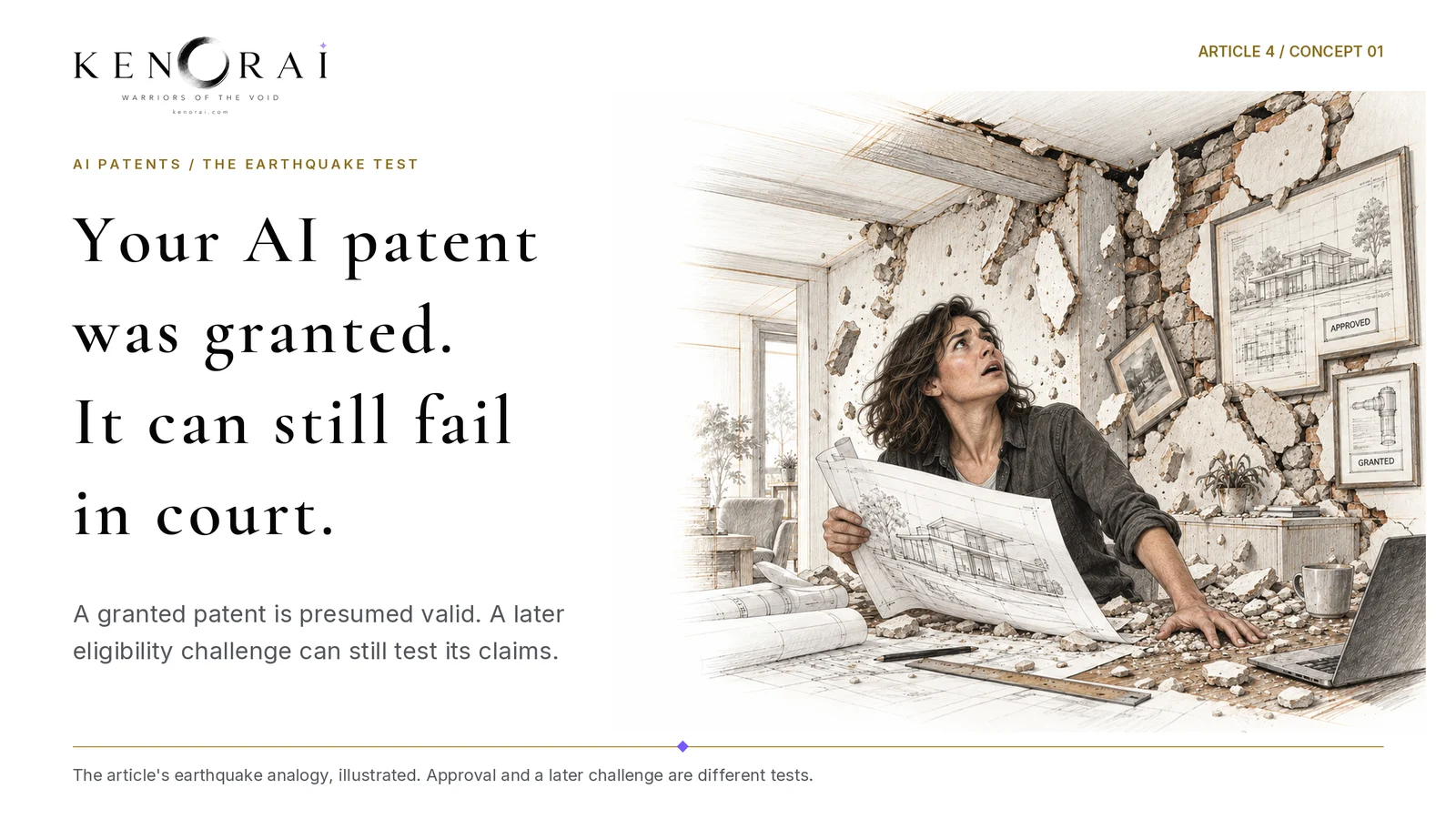
A permit is not an earthquake inspection
Think of building a house. The city approves your plans and hands you a permit. You frame that too. Then one night the ground moves, and the only question anyone asks is whether the building is still standing. Nobody from the permit office comes out. The earthquake never read your permit.
A patent works the same way. The patent office examines your application under its own guidance and grants it. Later, if you sue someone or get sued, a court looks at the same law without that guidance, and with the latest appeals-court rulings on the desk. Courts do start by presuming a granted patent is valid, so the grant helps. But the examiner was checking the plans. The court checks the building, during the earthquake, while the other side's lawyer is being paid by the hour to find the crack.
Two rulings, one line
In April 2025 the US appeals court that hears patent cases looked at patents on using machine learning to schedule live TV events and decide which shows air where. The court said that pointing a general-purpose machine learning method at a new kind of data isn't enough. The claims have to point to a real improvement, such as one to the machine learning itself. Doing the job faster than a person doesn't change that. The patents were thrown out.
Five months later the patent office drew the same line from its side. In Ex parte Desjardins, its review panel looked at a method for training a model to keep what it learned on earlier tasks while picking up new ones. It called that an improvement to how the model itself works, and said such improvements can be patented. The decision became precedential in November 2025, so examiners were told to follow it. The claims still lost, for being too obvious. One exam at a time.
So the two agree on where the line is. Generic machine learning on new data fails. A claimed improvement to the model can pass. The catch is who checks. Examiners follow the office's guidance. Courts aren't bound by it.
Why this matters right now
Gartner surveyed CIOs and other technology leaders in 2025 and again in 2026. The share with AI agents deployed went from 17 percent to 37 percent between the two surveys. More than double. McKinsey puts equity investment in AI infrastructure at about $145 billion in 2025 and nearly $384 billion in the first half of 2026.
McKinsey's patent signal for agentic software development is still modest, because the activity is product work rather than patents and papers. Granted patents trail filings by years. When those claims surface, how they were written will decide a lot.
The dish and the recipe
Imagine a chef who wins a competition with a risotto and then tries to patent "a delicious risotto." The judges loved the dish. The patent office would like to know what she did to the rice.
A dish is what the customer tastes. A recipe is how it gets made. You can write a patent claim about either one. Two made-up claims about the same invention, in illustrative wording rather than real patent language:
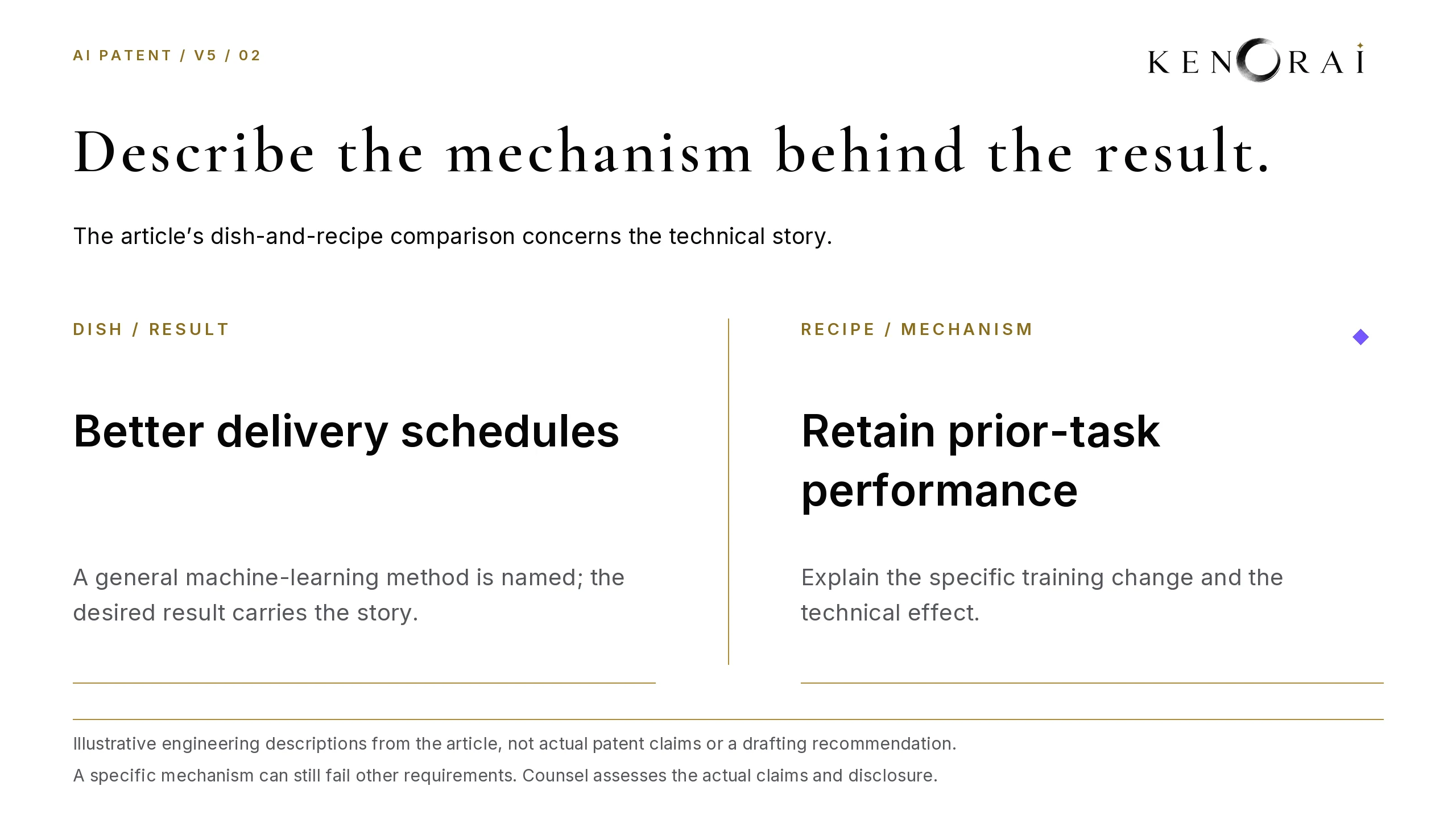
The dish: "A system that uses machine learning to produce better delivery schedules."
The recipe: "A training method that protects the parts of the model that matter most for earlier tasks while it learns a new one, so it doesn't forget."
Courts have thrown out the dish. A recipe that names a specific improvement has a better shot, at the office and in court. Very often it's the same invention. The only difference is which part got written down.
One trap catches smart teams. They point to the training, the updating, the "it learns as new data comes in" as the clever part. Courts have read those as built into machine learning, not improvements to it. A specific change to how it learns can count. "It learns" can't. That's the baker patenting "the dough rises."
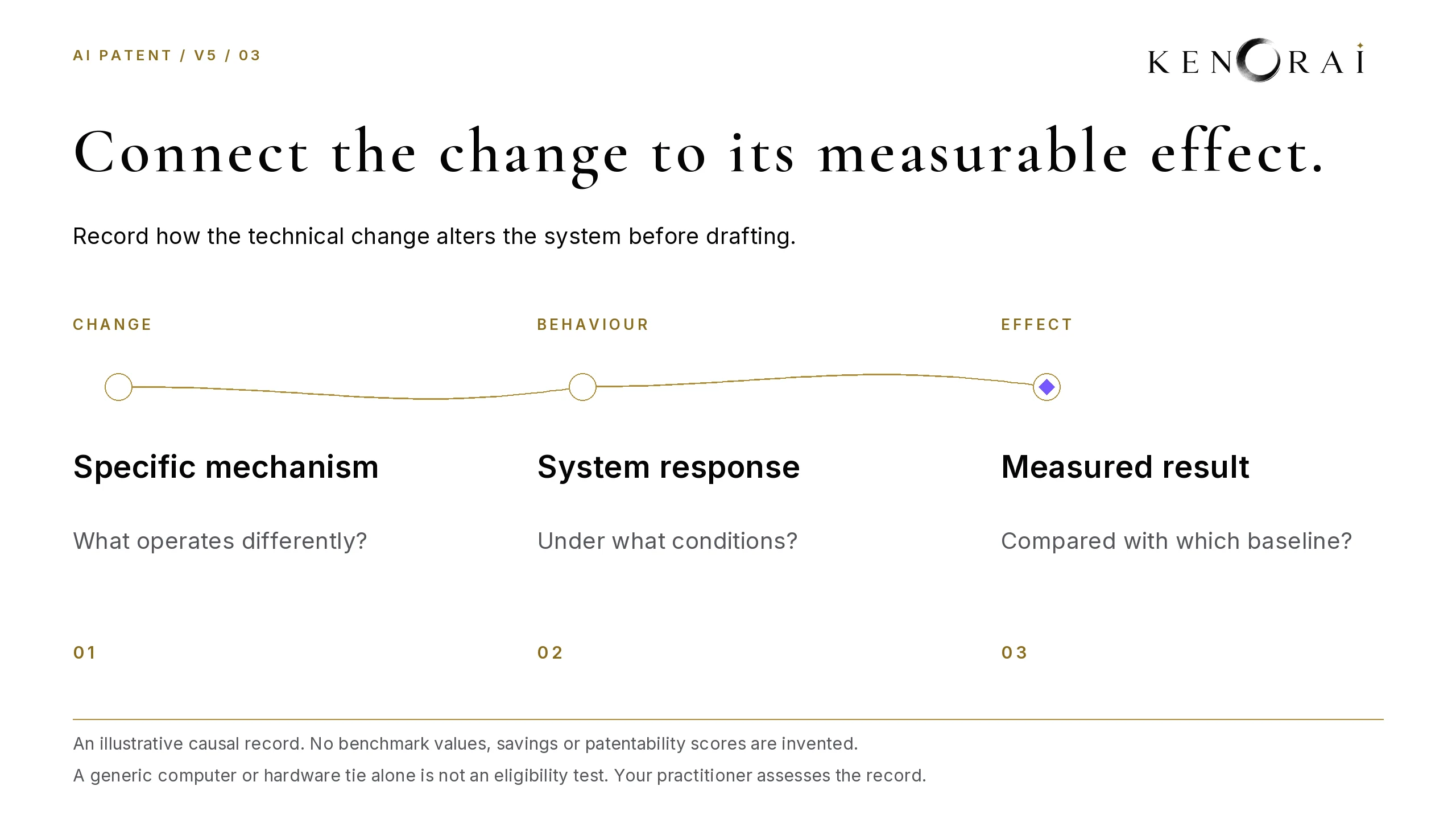
Now the quieter part of the opening scene, the part nobody noticed while the cake was being cut. The recipe was probably in your engineering wiki the whole time. Your team knew exactly how the system worked differently. It just wasn't the sentence anyone wrote into the claim. That's a fixable kind of problem, and a rarer one than it sounds.
Put a machine in the story
A brain in a jar is philosophy. A brain steering a robot arm is a machine.
One way through is tying the model to hardware in a specific way. A generic computer or sensor doesn't count. Think of a model controlling a robot arm under a strict time limit, or a sensor pipeline that changes what the hardware does. Machines are what the patent system was built for.
Industry is heading there anyway. McKinsey names hardware and software co-design as one of five cross-cutting themes for 2026. The trap is drafting that drops the hardware to widen the claim. Wider on paper, easier to knock down. It's taking out the load-bearing wall to make the living room bigger.
Same invention, different exam in each country
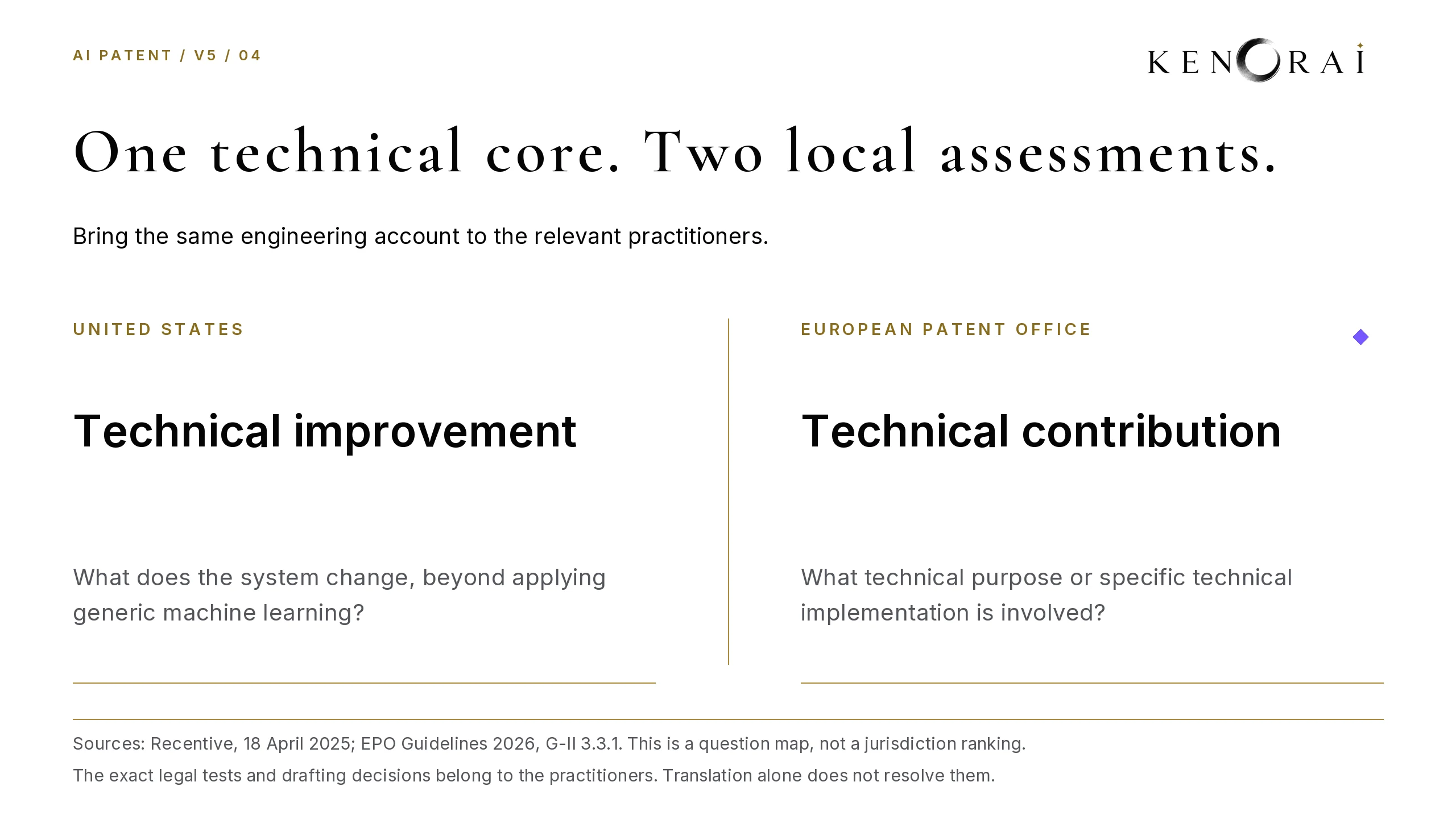
Europe has its own test. Its patent office treats a machine learning model as plain math unless it serves a technical purpose or a specific technical implementation, and it may want the training details spelled out. A claim set written for the US and then translated can land weaker in Europe.
A sworn statement can't write the story for you
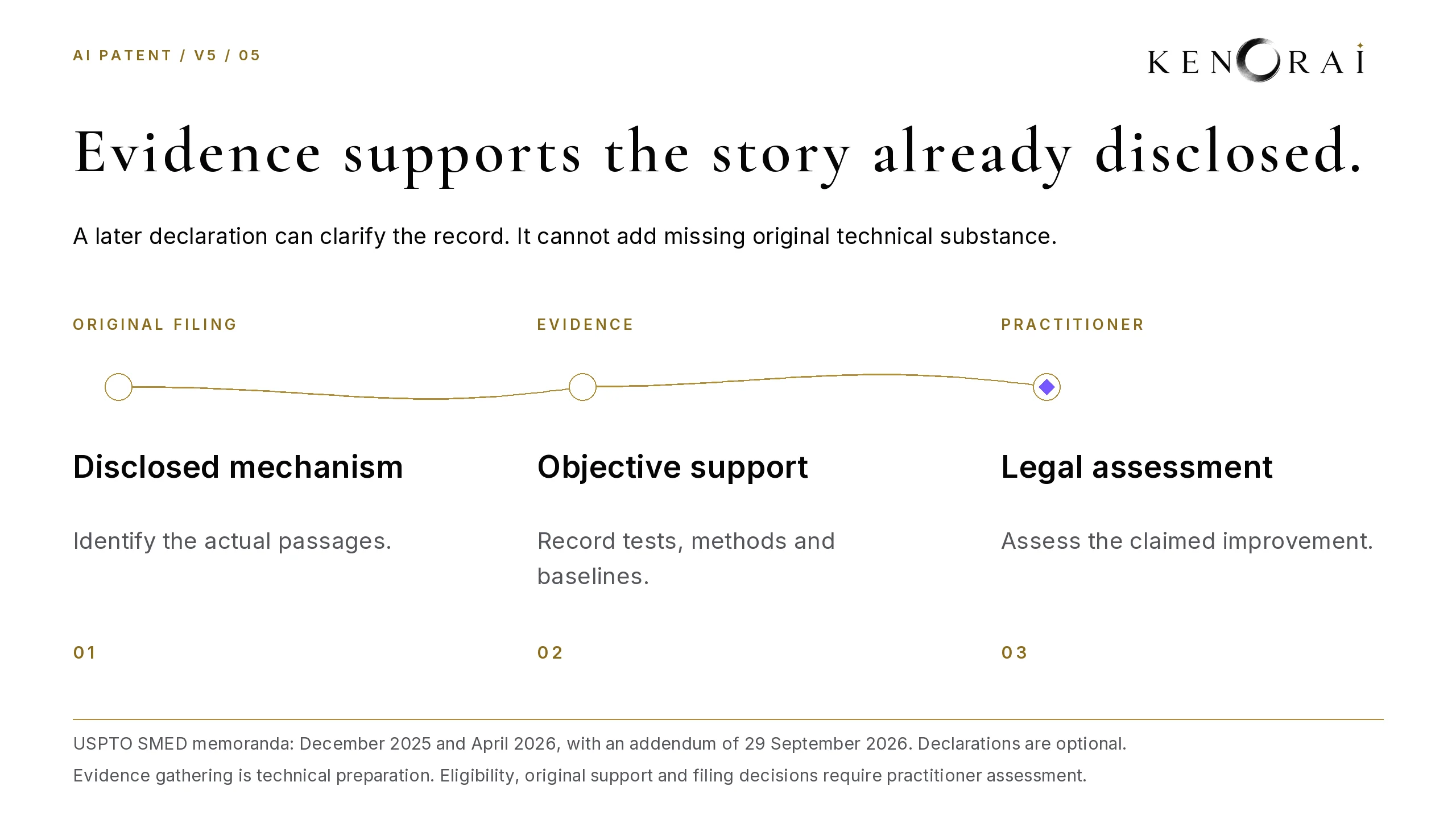
The US office now explains how applicants can use sworn declarations, with objective evidence, to show an invention improves the technology. Declarations are decades old. What's new is the office's guidance on using them for eligibility, issued in December 2025 and updated in April 2026.
That sounds like a safety net, with a catch. A declaration can back up a technical story that's already in the filing. It can't add one that's missing. A stress test can show a beam holds. It can't add a beam the drawings left out.
So the work moves to before drafting, while the benchmarks can still be run and the engineer who ran them hasn't left to start a company.
Check your own AI patents in five steps
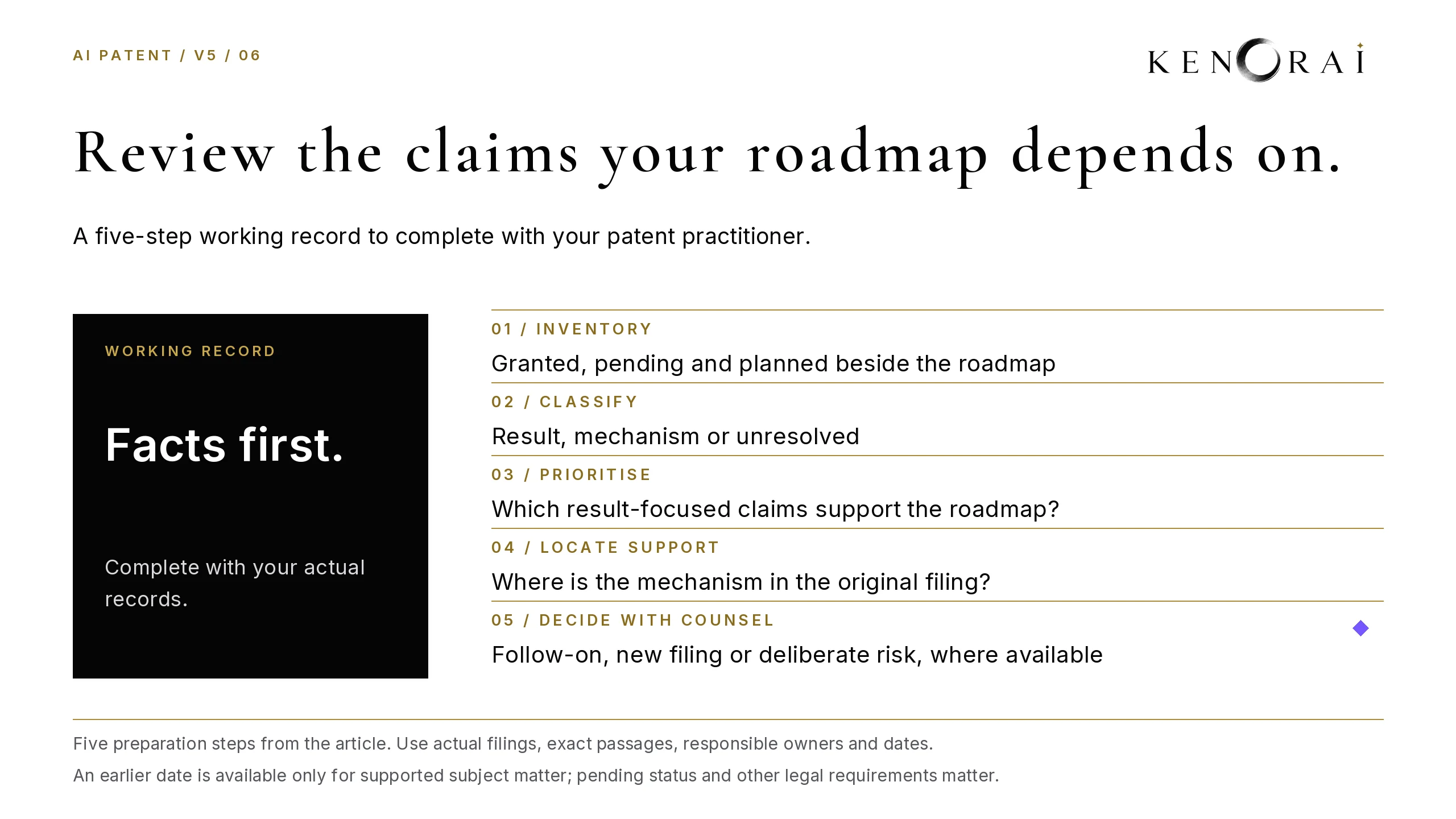
Do this with your patent attorney or agent, before your next filing.
- Lay your AI patents and applications (granted, pending and planned) next to your product roadmap.
- Label each one. Dish: the claim is about what the model achieves. Recipe: it's about how the system works differently.
- Circle the dish claims your roadmap depends on. That's your exposure.
- For each circle, ask whether there's a recipe inside the same invention, and whether its technical story is in the filing at all.
- Decide with counsel: a follow-on filing that keeps the original date (only for what the first filing already described), a new filing, or living with the risk on purpose. Which of these is open depends on what's still pending.
Mistakes that cost the most
- Treating the grant as a win. It's one examiner's view, not a court's.
- Claiming the dish. What the model achieves, instead of how the system works.
- Calling training or live updating "the invention."
- Dropping the hardware to widen the claim.
- Writing once for the US and translating.
How Kenorai fits
Kenorai builds the technical record the dish-or-recipe decision runs on: a diagram of how the system works, the technical problem in engineering terms, a table of which feature causes which measurable effect, a benchmark plan run while the work is fresh, and the technical story the US and Europe each look for, written from one common core. Then we read it the way a skeptical outsider would and list where the support, the benchmarks or the mechanism look thin, for your attorney to assess.
We don't give opinions on patentability, validity, infringement, freedom to operate or inventorship, and we don't draft or file. A registered patent attorney or agent does, and we work with whichever one you choose. We hand them the substance and the evidence before the drafting decision, not after.
The takeaway
A grant is the friendly yes. Staying standing takes a yes from a stranger who has every reason to say no, and a budget to go looking for it.
Homework: ask your patent attorney or agent to walk you through your last three AI filings. For each one, is it a dish or a recipe? If nobody can tell you, that's useful to know, and it's cheaper to learn now than from a motion.
Kenorai is offering a free consultation plus an initial landscape read on one technology through November 11, 2026. An NDA is available before you share anything. Start at kenorai.com/contact.
The opening scene is invented and refers to no real company or matter. This article reports public developments and published surveys. It is not legal advice and is not an opinion on any patent, application or matter. Questions about your own portfolio belong with your own counsel.
Kenorai Ltd is not a law firm and nothing here is legal advice.
Sources
- Recentive Analytics, Inc. v. Fox Corp., 134 F.4th 1205 (Fed. Cir. 2025).
- Ex parte Desjardins, Appeal No. 2024-000567 (PTAB Appeals Review Panel, Sept. 26, 2025), precedential Nov. 4, 2025.
- USPTO subject matter eligibility declaration memoranda, Dec. 4, 2025, and April 30, 2026.
- EPO Guidelines for Examination, 2026 edition, G-II 3.3 and 3.3.1.
- Gartner, 2027 CIO Agenda Preview, 2026.
- McKinsey & Company, Technology Trends Outlook 2026, September 2026.

No comments yet