
The press release goes out on a Tuesday. By Wednesday every competitor in your category has read it, looked at the number, and drawn the obvious conclusion: you now have the money to build the thing you have been hinting at for a year.
Congratulations. You just published your roadmap.
The filing race started the moment the announcement hit. The only open question is whether you entered it.
A funding announcement is a public signal
Founders experience a round as a private achievement that gets a public moment. Competitors read it the other way around. The amount, the investors, the quoted ambition in the second paragraph: all of it is intelligence about where you are going next.
It is like posting your travel itinerary online before you leave the house. You meant it as good news. Someone else reads it as a schedule.
Be precise about what the announcement gives away. It does not hand a rival your invention; if it did, your own disclosure would count against their filing. It hands them your direction. A sharp rival with decent patent counsel can read your announcement, look at their own roadmap, and identify the two or three technical positions you are most likely to need next year. Then they can build toward those positions themselves, and file first.
That is not paranoia. That is first-to-file working as designed.
The second broadcast
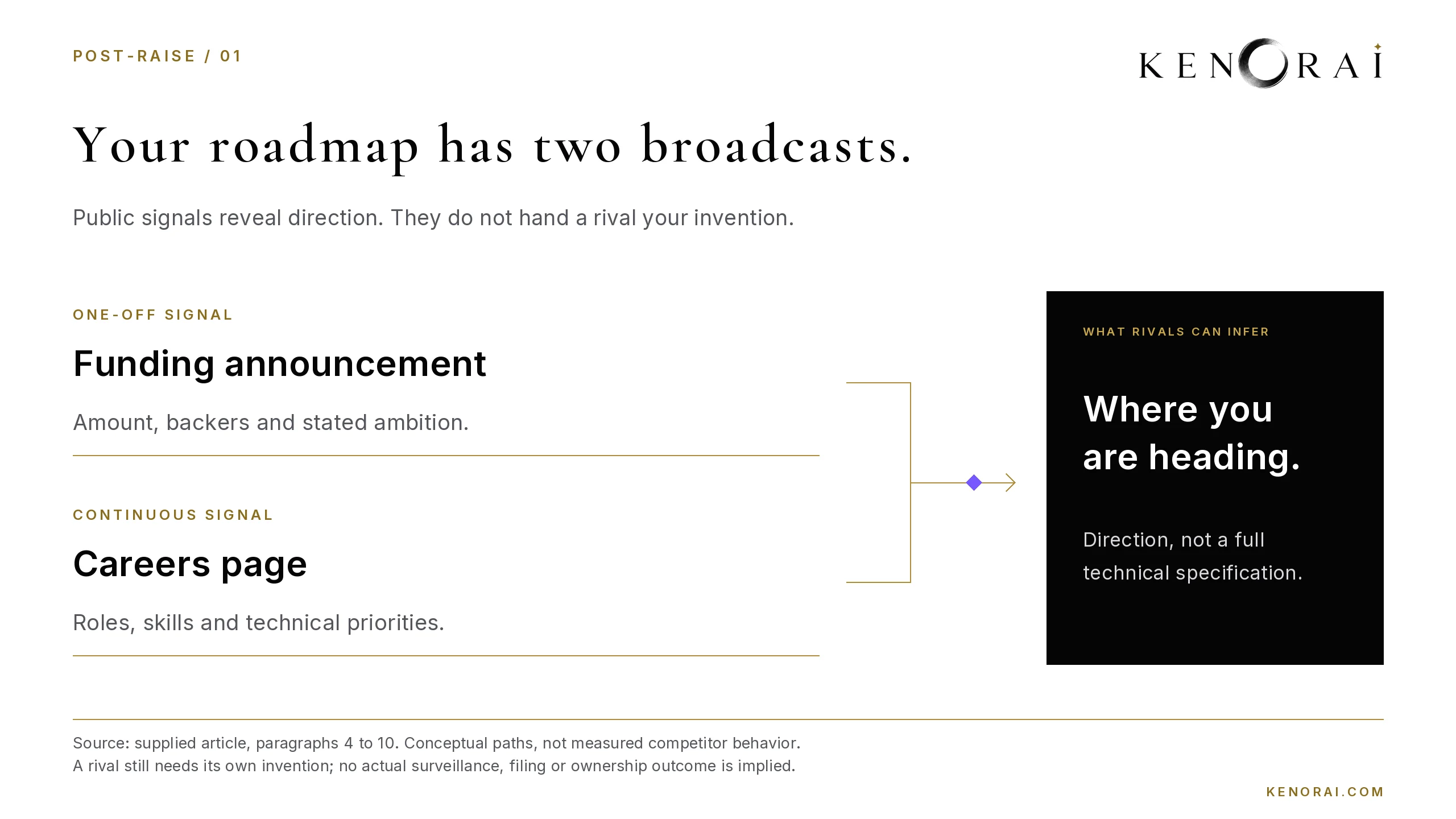
The press release is not the only signal you are sending.
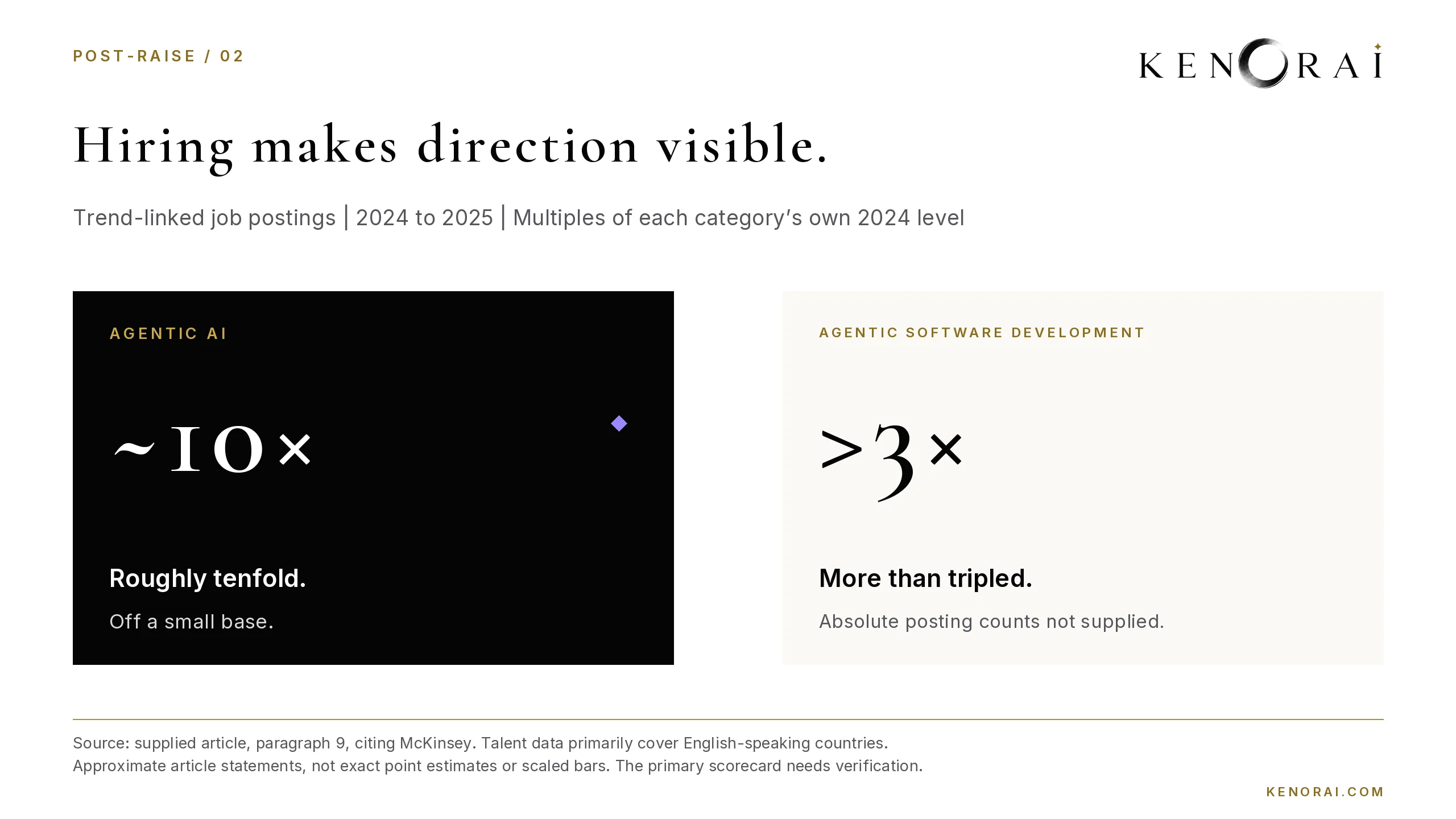
When McKinsey tracks where innovation is happening across fourteen technology areas, one of its six measures is job postings. Hiring is a public, machine-readable statement of what a company is about to build. Postings for agentic AI roles rose roughly tenfold between 2024 and 2025, off a small base. Postings for agentic software development more than tripled. Analysts watch this. So do competitors.
So the week after your raise, when you post for three machine learning engineers and a controls specialist, you have told the market which problem you are solving next. Your careers page is a second press release, and it runs continuously.
The calendar decides, not the lab notebook
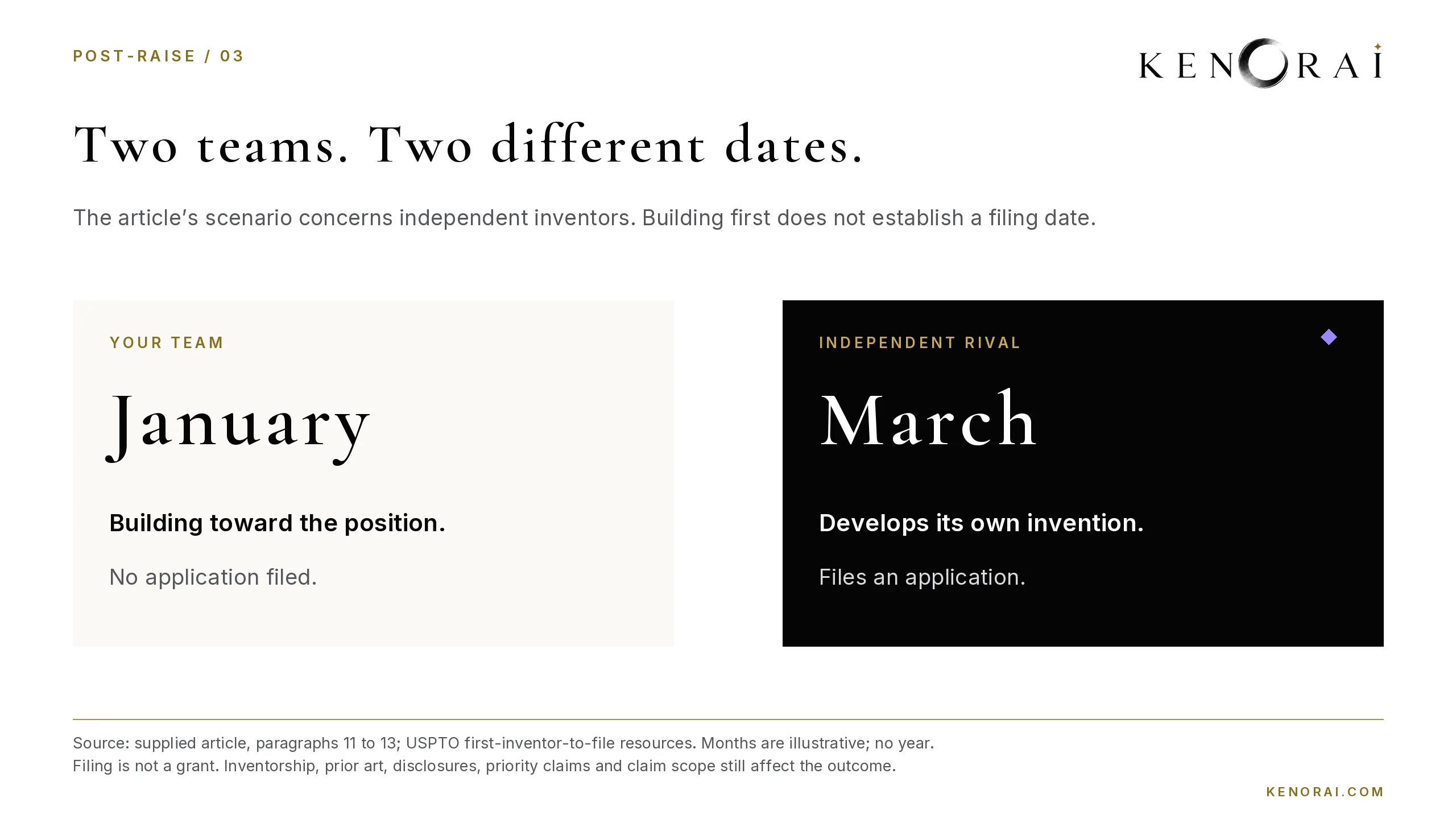
A mining claim goes to whoever stakes it and records it first, not to whoever found the seam. Between independent inventors, patents are the same. Priority goes to whoever files first. Not who thought of it first, not who has the earlier commit history.
A competitor who worked out where you were heading, built it independently, and filed in March can own ground you were already building toward in January but had not yet filed on.
Founders who came up through engineering often find this hard to accept, because it feels unjust. It is. It is also the rule, and the rule does not bend because you disagree with it.
Why this particular window is cheap
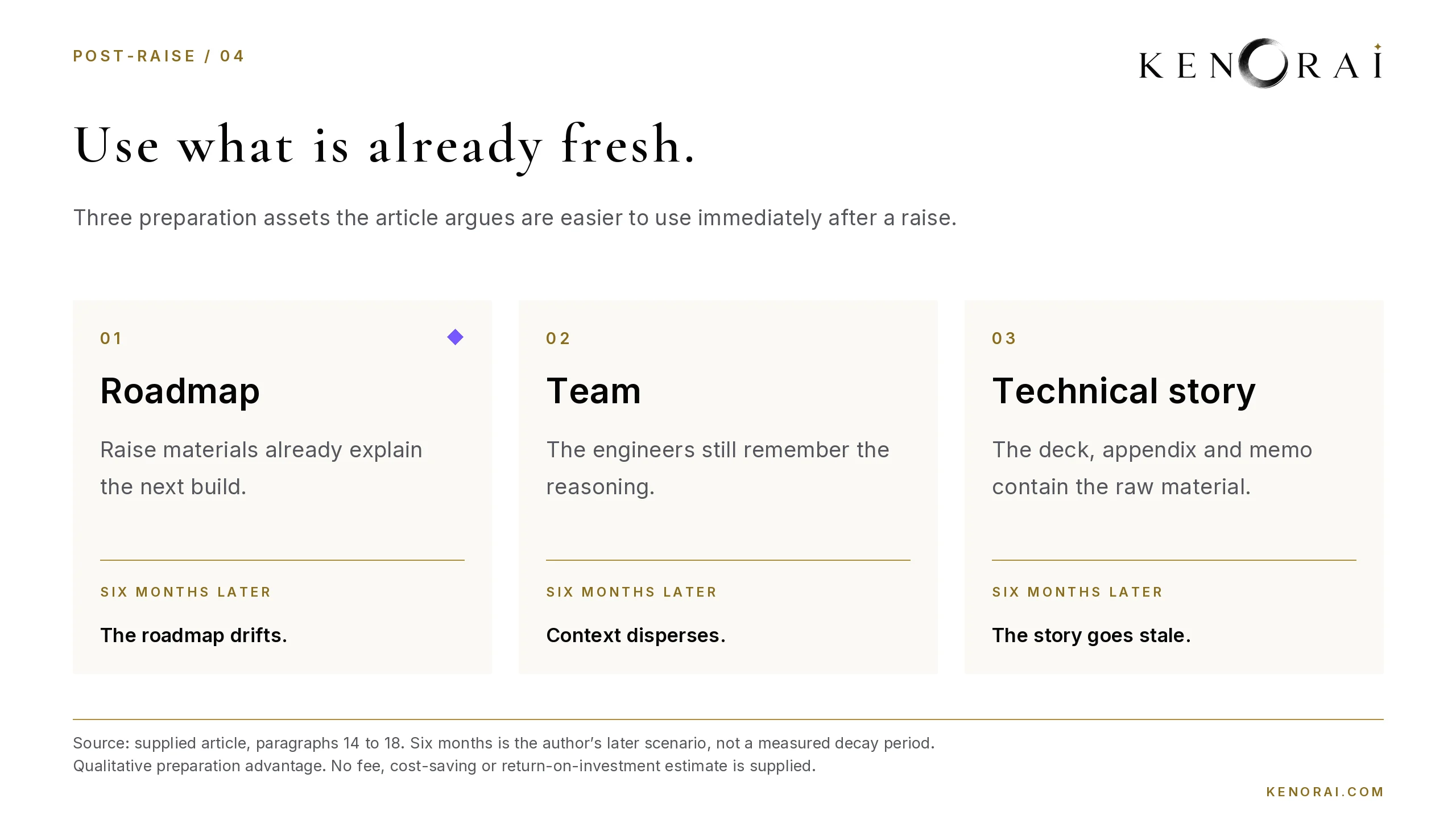
The ninety days after a raise are the cheapest and highest-value patent window most companies ever get, for three reasons that will not all be true again.
The technical roadmap is fresh. You just spent months explaining what you will build and why it matters. That explanation is the raw material of a patent filing.
The team is aligned. The engineers who closed the round by explaining the invention are still in the room, still remember the reasoning, and have not yet been pulled across three new product lines.
The invention story is already written down. It is in your own deck, your own technical appendix, your own investor memo. Half the work of describing the invention is done, and you did it to raise money rather than to file.
Six months from now, all three decay. The roadmap drifts. The team fragments across new hires. The clean version of the invention story lives only in a deck nobody opens.
What happens instead
IP drops to the bottom of the post-raise stack.
Above it sit hiring, product, the first big customer push, the new office, and a dozen board-requested reports. Each of those has a visible deadline. Patents have none, until they suddenly do.
So the window closes silently. No email arrives saying your filing window expired today. Nothing breaks. The company keeps shipping. The only evidence that anything was lost surfaces later, in a different room.
Diligence is where the delay gets priced
That room is the data room at your next round.
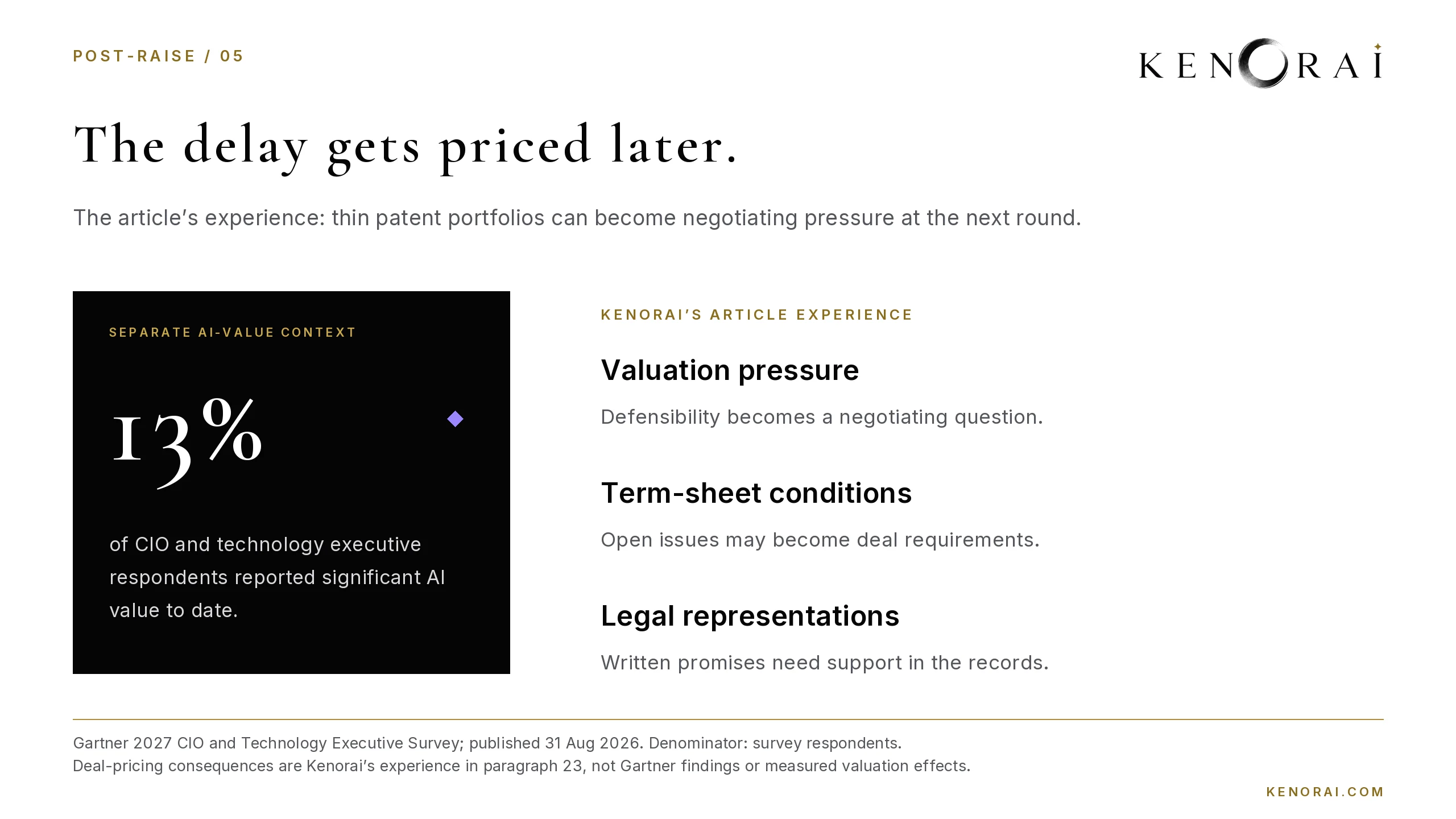
In our experience, thin patent portfolios rarely kill deals. They price them. A Series B investor looking at a company with two thin provisional filings and a roadmap that depends on five unclaimed positions does not walk away. They adjust. Valuation pressure, term-sheet conditions, a line in the legal representations, meaning the written promises you make about what you own, that makes your lawyer wince.
The market explains why scrutiny has sharpened. Gartner's 2027 survey found only 13 percent of CIOs and technology executives reporting significant value from AI to date, and a separate Gartner analysis puts the share of AI initiatives delivering a return at about 20 percent. Investors have watched a lot of money chase AI claims that did not hold up. In what we have seen, diligence teams respond by digging into what a company actually owns rather than what the deck says it does.
Those teams are also starting to ask how much of the engineering work was AI-assisted and whether the company can show which humans conceived what, which is a records problem most teams have never been asked to solve. That is a separate article.
The cost of the delay was always going to be paid. The post-raise window was simply when it was cheapest.
The ninety-day sequence that works
Founders who get this right do roughly the same four things, in order, inside the first quarter after close.
- Inventory the invention flow. Go back through the raise materials and the engineering work of the last six months. List every technical thing you built, solved, or designed around that a competitor would want. Do not filter yet.
- Map the terrain around it. For each item, find out which published filings and public disclosures sit nearby, and how much confidence that read deserves. Broad-brush is fine at this stage.
- Prioritize against the roadmap. Keep only the positions your next eighteen months depend on. Rank them by how exposed you would be if someone else held them.
- Decide deliberately. For each position: file, hold as a trade secret (protected by confidentiality rather than registration), or leave open on purpose. Write it down with an owner and a date.
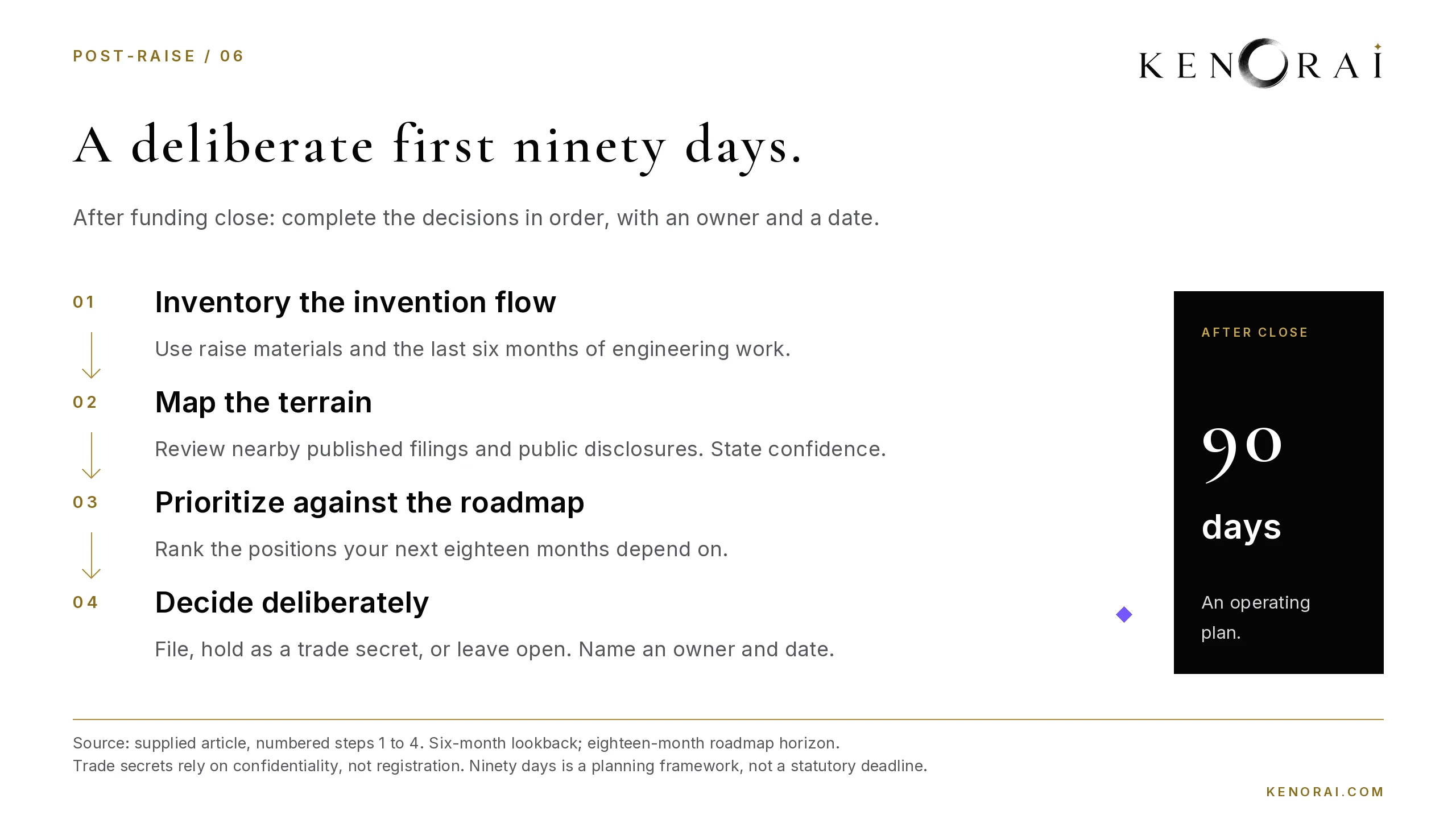
The sequence says what to do and in what order. Doing steps two and three well is a discipline of its own, and it is the part most teams underestimate.
Six questions that locate the window
A founder can score the window in ten minutes with six questions. They cover invention flow (do you know what you built?), terrain awareness (do you know what is public around it?), filing posture (have you decided, or are you drifting?), and ownership (does one named person own this decision?).
If you can answer all six with a name and a date, the window is open. If three or more answers are "we should probably look at that," it is closing. If the round closed more than a quarter ago and nobody has asked these questions, assume it is gone and start the recovery.
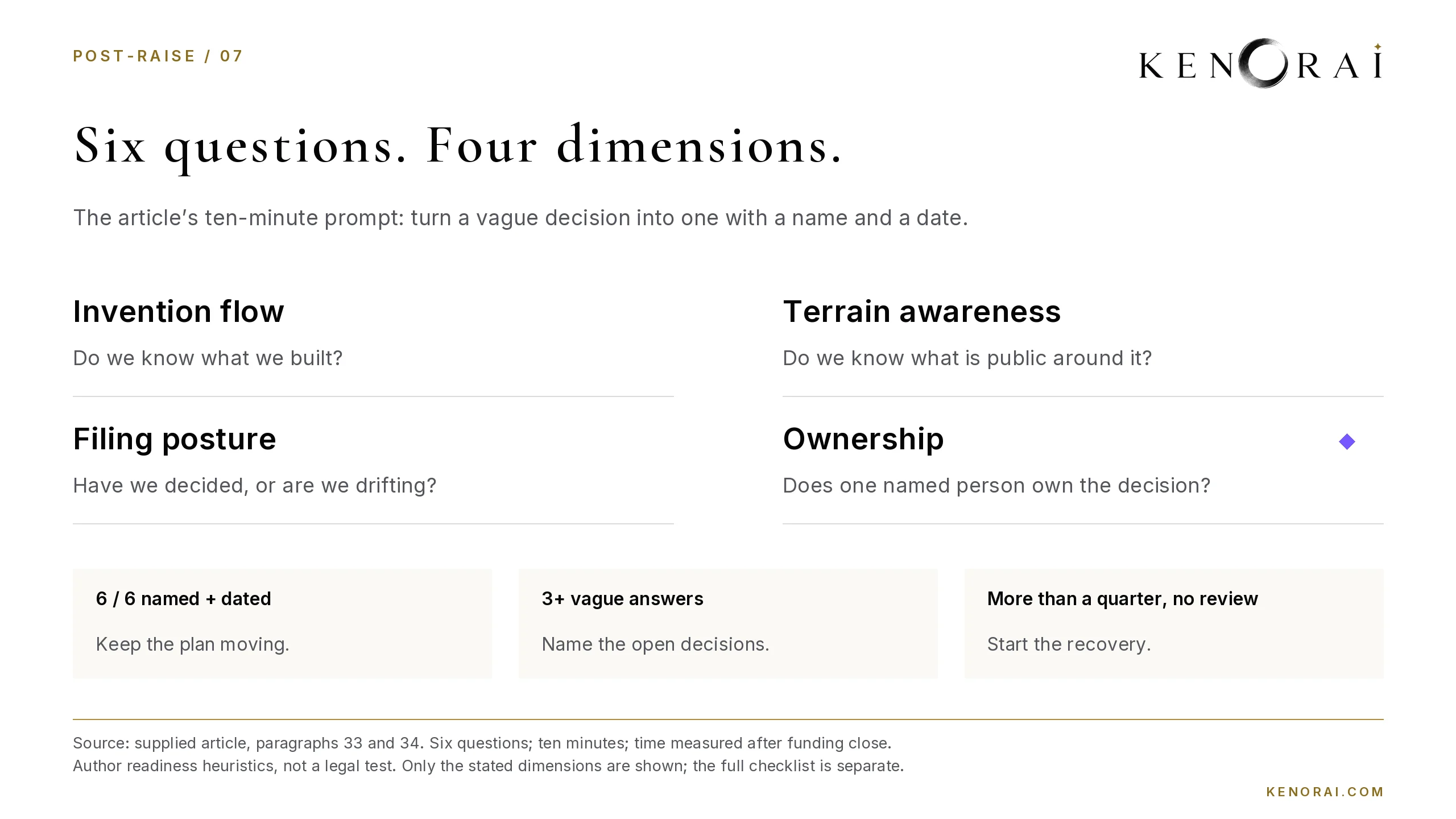
The full checklist is linked in the first comment.
Common mistakes
- Waiting for patent counsel to raise it. Outside lawyers respond to instructions. In our experience they do not chase you.
- Filing only what is already built. The roadmap is the target.
- Treating trade secret as the default. It is a decision with costs of its own.
- Assigning IP to "the team." Unowned decisions do not get made.
- Assuming the announcement was harmless. It was the starting gun. So is the careers page.
How Kenorai fits
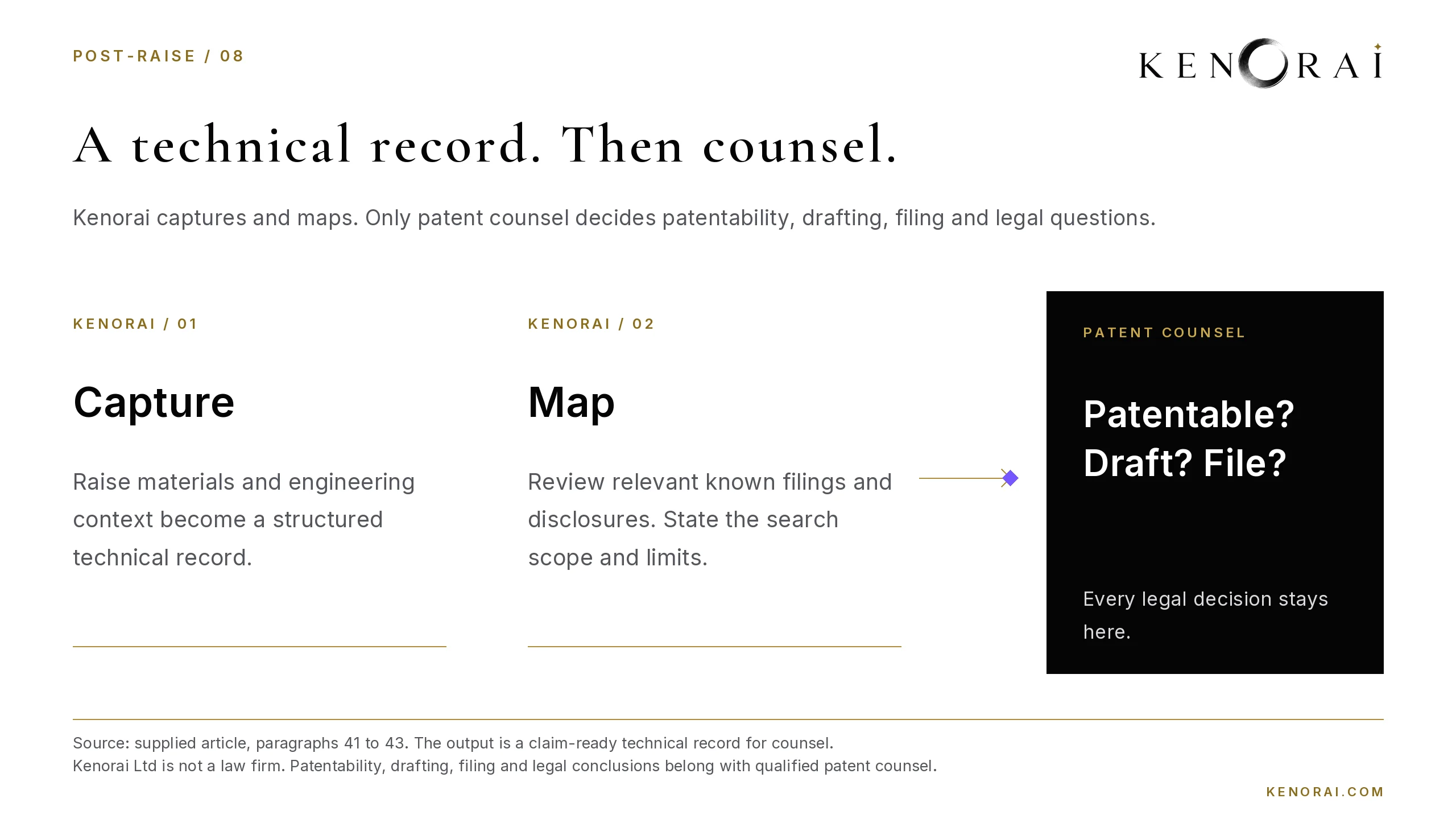
Kenorai runs the first two steps of that sequence, which are the two most often skipped.
Structured invention capture works through the raise materials and the recent engineering work with your team and turns it into a technical record. What was actually built. Which mechanism is doing the work. What the alternative implementations are. Where the technical effect can be measured. Terrain mapping then places each candidate against the most relevant known filings and disclosures, with the search scope and its limits stated, and ranks what survives against your roadmap.
What counsel receives at the end is a claim-ready technical record rather than a folder of engineering notes and a meeting. What counsel decides, and only counsel, is whether anything is patentable, what gets drafted, what gets filed, and every legal question underneath those choices.
The asymmetry
You can out-hire a competitor. You can out-ship them and out-raise them.
You cannot out-hire a competitor who owns the ground under your roadmap. Every engineer you add builds faster toward a position somebody else holds.
If you closed a round in the last ninety days, which of the six questions can you answer with a name and a date today?
Written by: Jan R Gerards
Kenorai Ltd is not a law firm and nothing here is legal advice.


No comments yet