Every founder gets asked the same question in the first meeting: what stops someone bigger from doing this?
Most answers describe a moat the company hasn't dug yet: the brand customers will come to trust, the network that grows with every user, the switching costs that hold customers once they've arrived. All of these are real and valuable, and all of them are years away for a company with two employees and a prototype.
There is one kind of moat a startup can begin building before it has a single customer. It's the one most founders under-fund.
Why this matters now
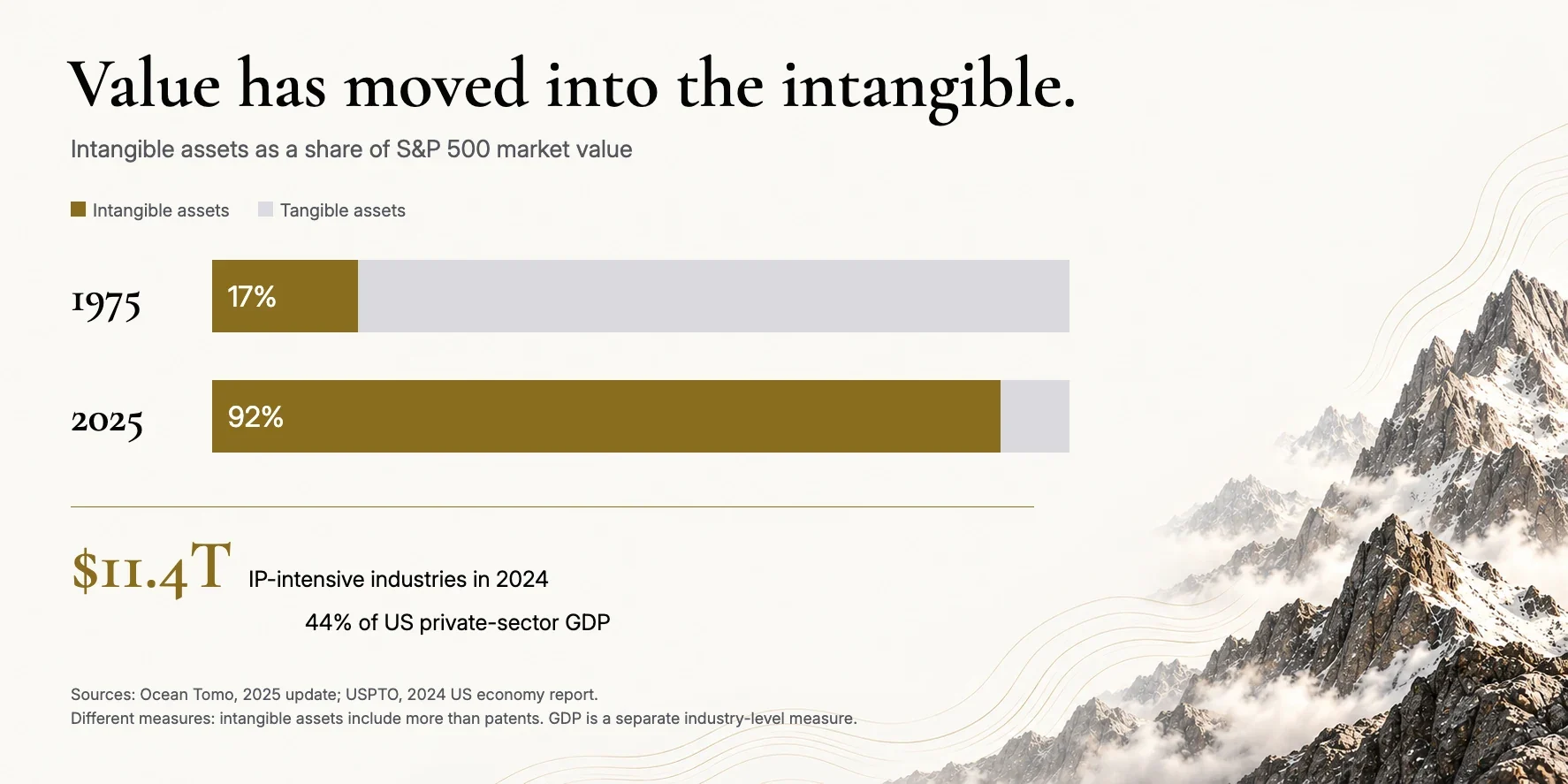
Value has moved almost entirely into things you can't touch. By Ocean Tomo's count, intangible assets made up roughly 17 percent of S&P 500 market value in 1975 and about 92 percent by the end of 2025. In the US economy, the USPTO reports that industries relying most heavily on patents, trademarks and copyright produced $11.4 trillion in 2024, or 44 percent of total private-sector GDP.
Investors have adjusted accordingly. Capital is harder to raise than it was in 2021, diligence runs deeper, and when an investor asks what stops a competitor, what they mean is which of your moats they can underwrite today. A patent filing is one you can put in front of them.
What a moat is, and the kinds a company can have
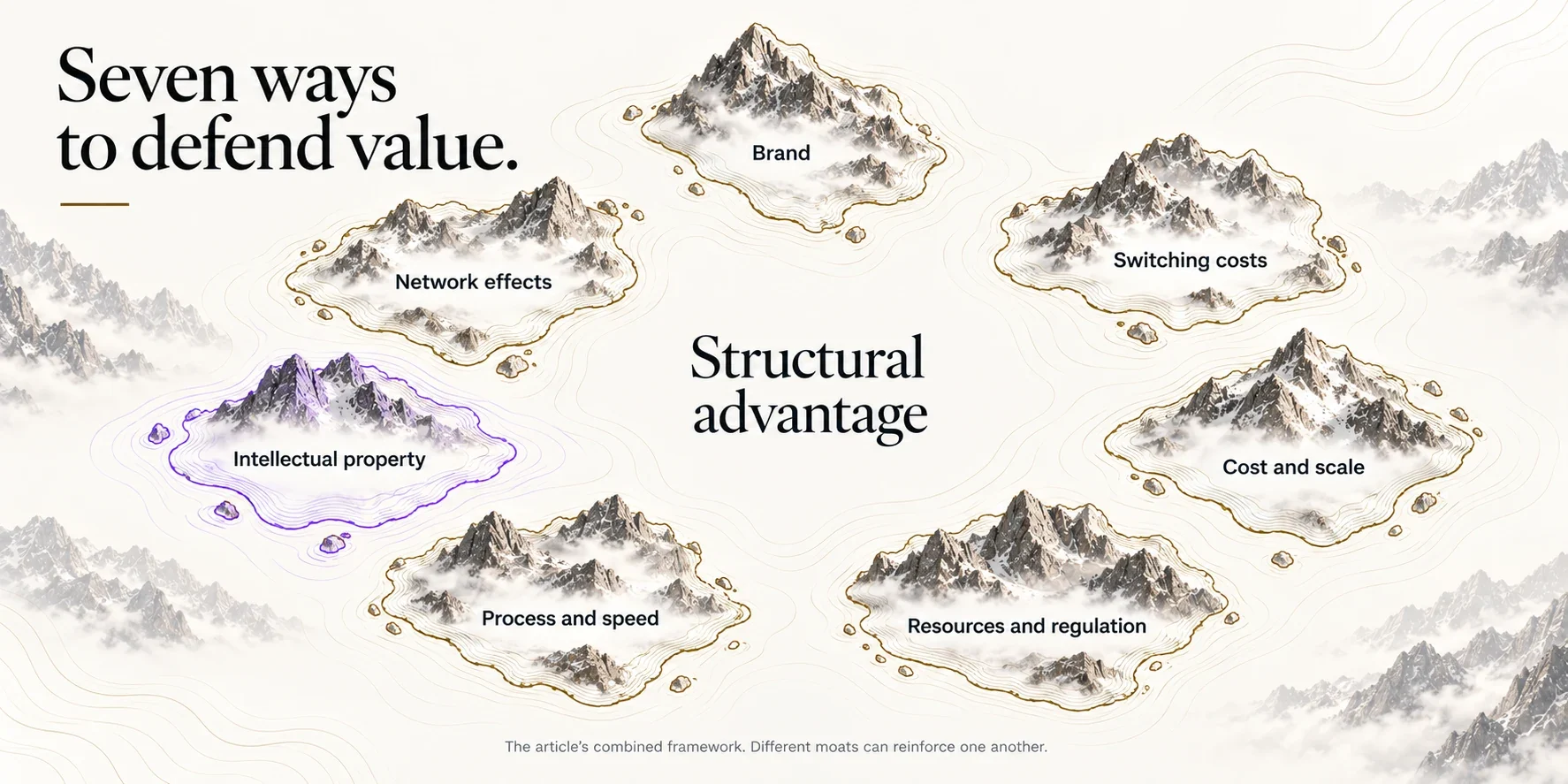
A moat is any structural advantage that lets a company sustain above-normal returns while competitors try to erode them. Investors, Morningstar among them, have classified the durable ones. Combining those frameworks, startups can build seven:
- Brand. Customers choose you on reputation and pay a premium for it.
- Network effects. The product gets more useful as more people use it.
- Switching costs. Leaving you is expensive, disruptive, or risky for the customer.
- Cost and scale advantages. You produce more cheaply than anyone smaller can.
- Cornered resources and regulatory position. You control a scarce input, a license, or an approval others can't easily get.
- Process and speed. You execute better and ship faster, so rivals are always behind.
- Intellectual property. Patents, trade secrets, and trademarks give you legal rights over what you've built.
All seven matter over the life of a company. At seed stage, a patent application is one of the few an investor can actually examine.
Why the patent moat is different
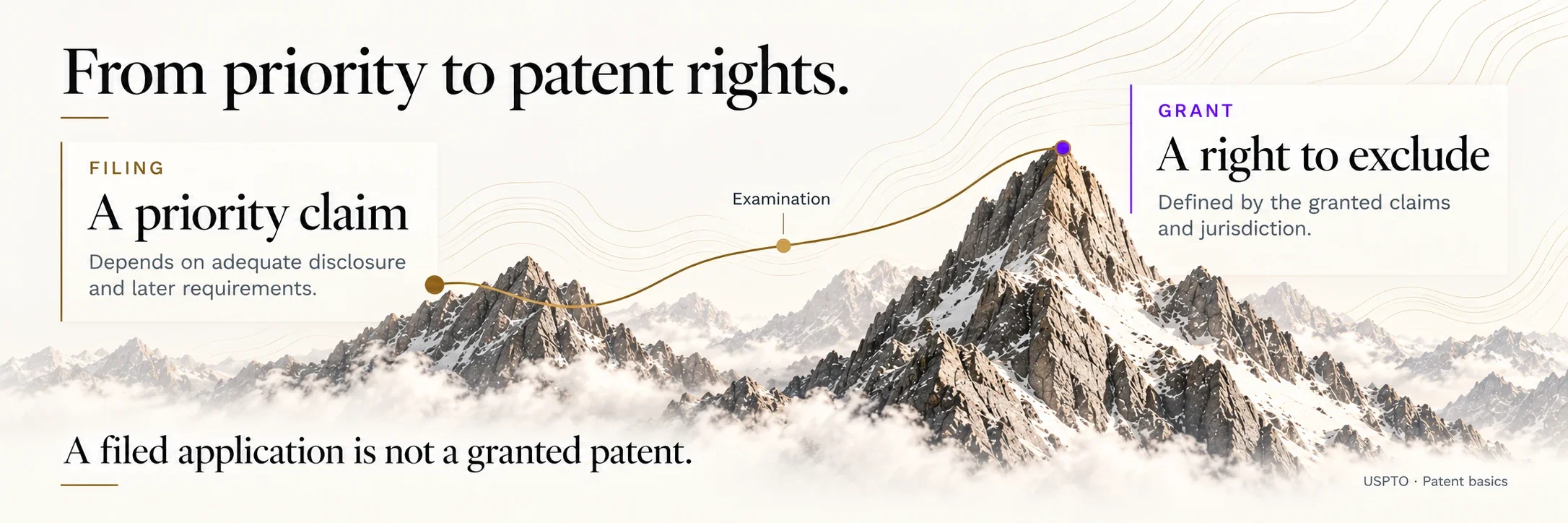
It starts at the filing date. A brand needs customers. A network needs users. Switching costs need contracts. Scale needs volume. A well-supported application can establish an early priority date, subject to the applicable requirements. Enforceable patent protection depends on the claims that ultimately grant.
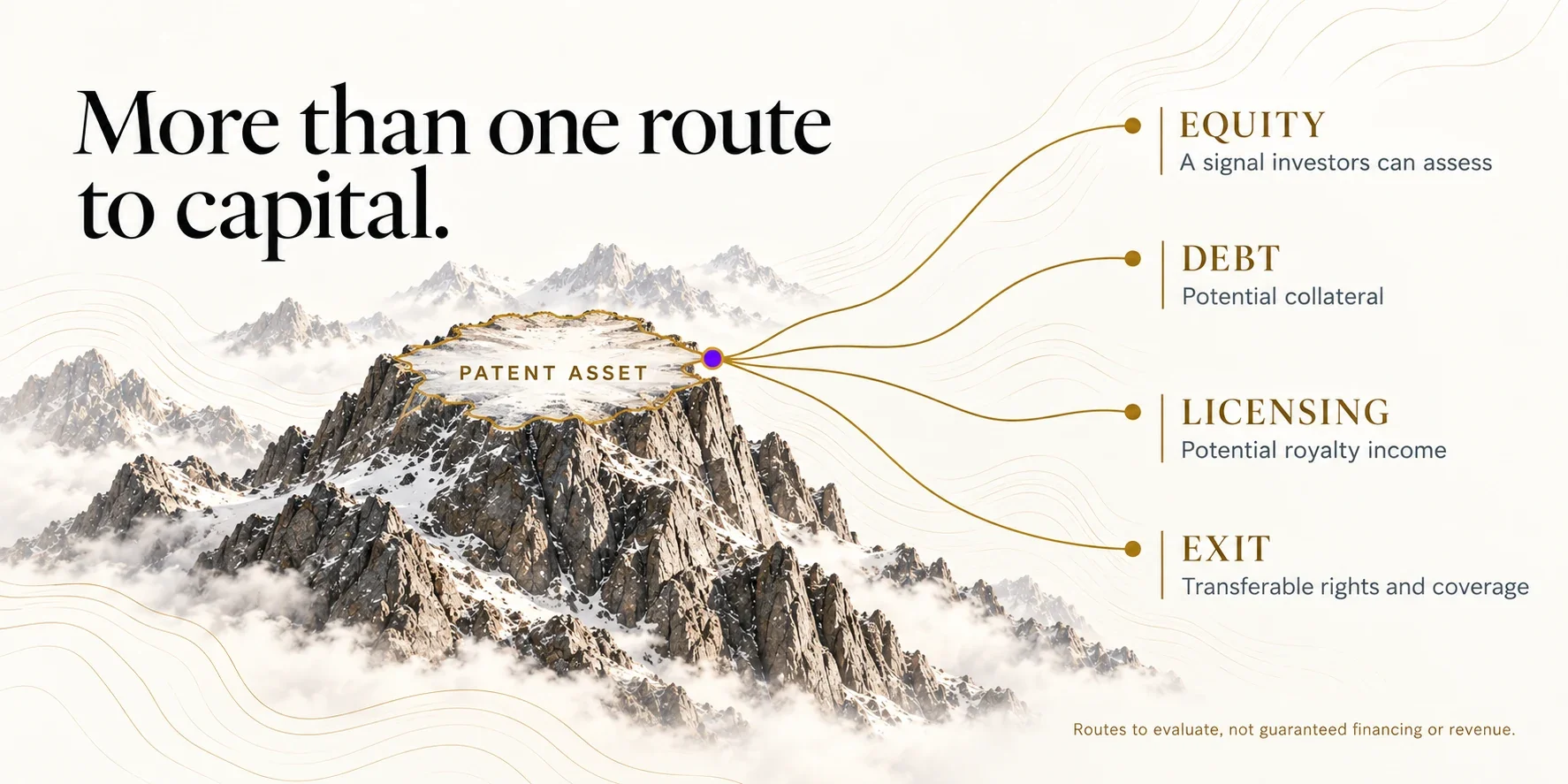
It becomes a legal right, not just an outcome. Every other moat describes how the market currently behaves toward you, and the market can change its mind. A granted patent is a government-backed right to exclude others, running twenty years from the earliest filing date for a utility patent, subject to maintenance fees, term adjustments and the jurisdictions where it was obtained. It can be licensed, assigned, pledged and sold.
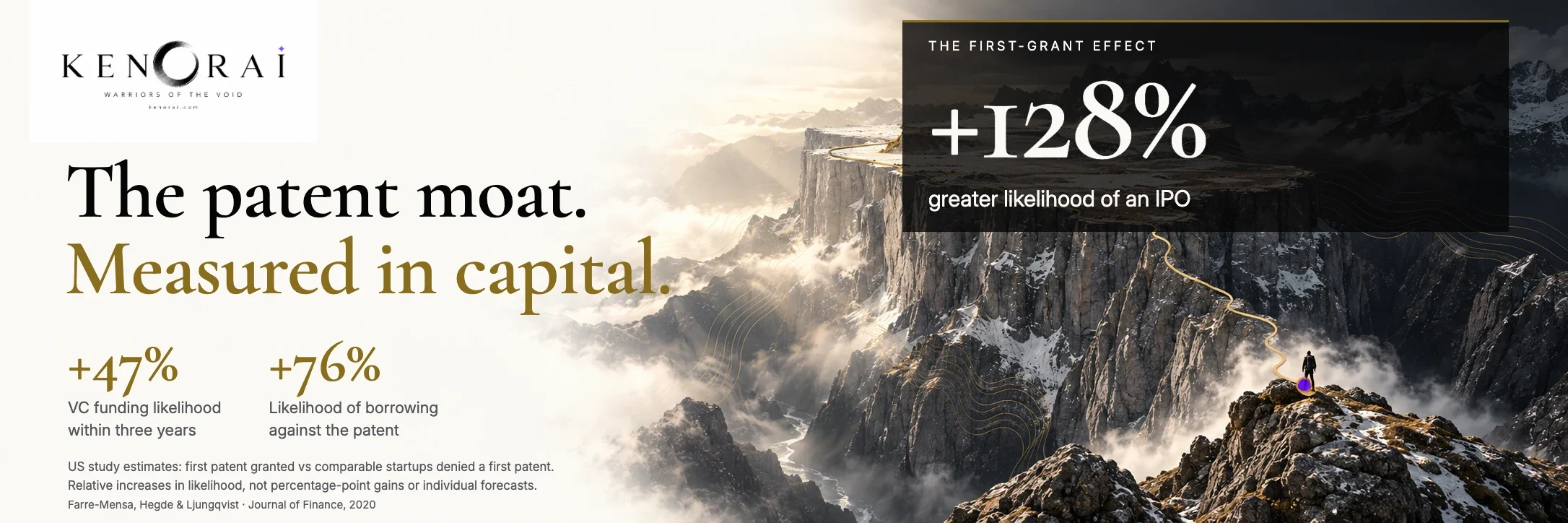
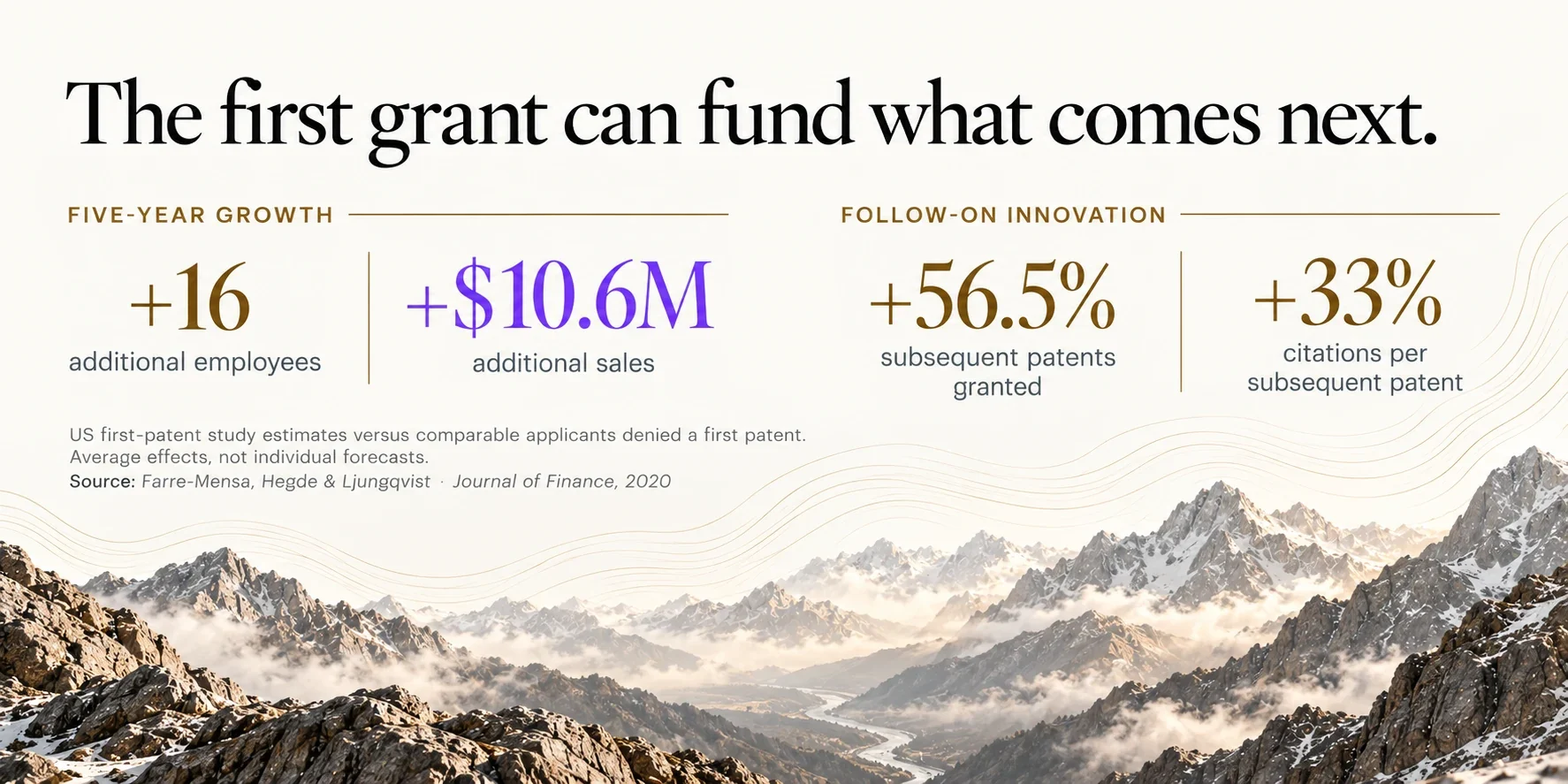
It is the moat with the strongest causal evidence behind it. In 2020, economists Joan Farre-Mensa, Deepak Hegde and Alexander Ljungqvist published a study of 34,215 first-time patent applications by US startups. Because the patent office assigns applications to examiners at random, and some examiners approve far more often than others, two similar startups can receive different outcomes by chance. That lottery isolates what the patent itself does. Startups that won their first patent were:
- 47 percent more likely to raise venture capital within three years
- 76 percent more likely to secure a loan with the patent as collateral
- 128 percent more likely to go public
These are relative increases, not percentage-point gains. Those startups added about 16 employees and $10.6 million in sales over five years, received 56.5 percent more subsequent patent grants, and citations per subsequent patent were 33 percent higher. The funding lift was strongest for inexperienced founders, and for companies in crowded startup hubs like California, Massachusetts and New York, where a patent helps a company stand out from the field competing for the same attention.
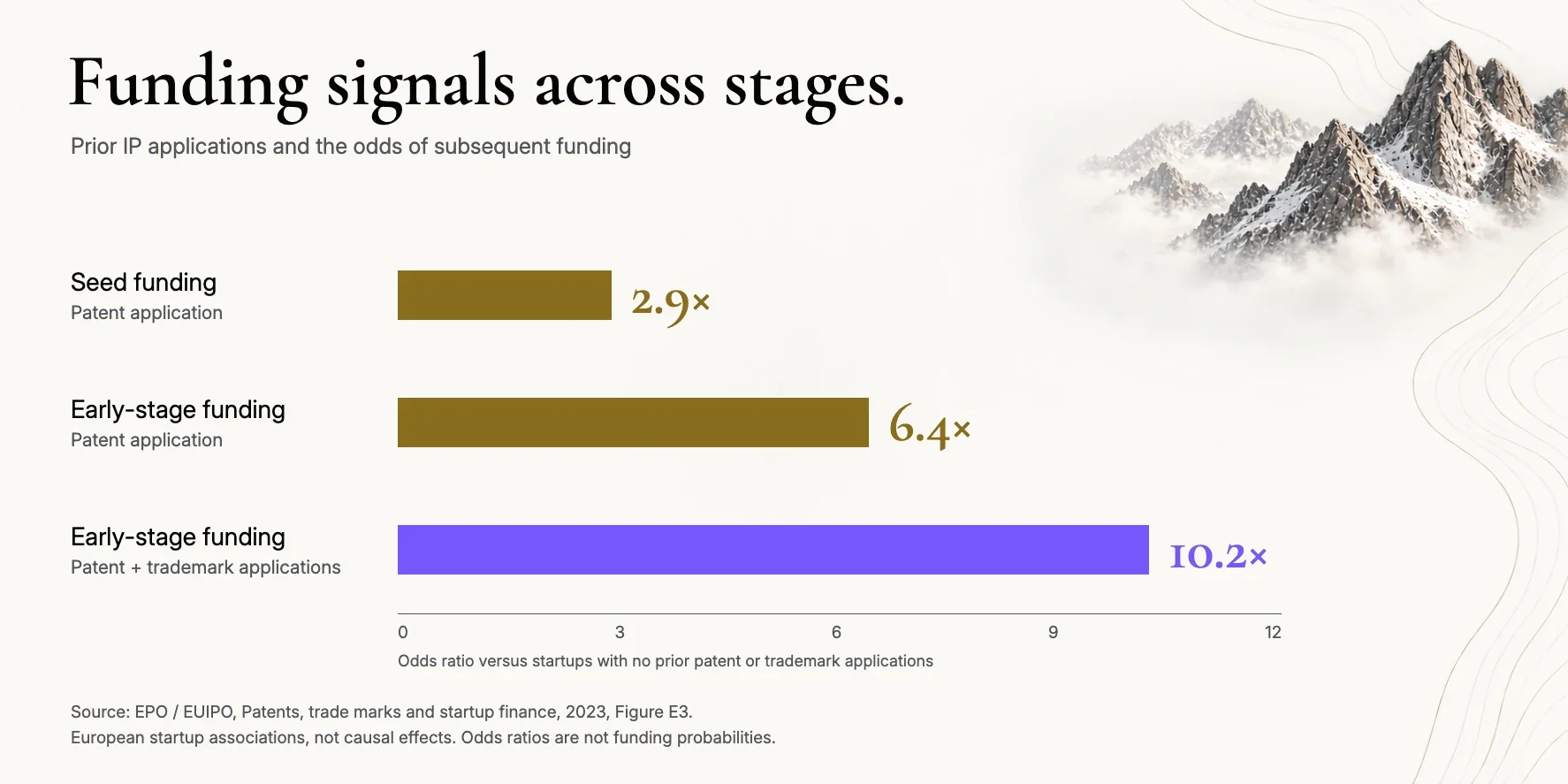
Investors price it at every stage. A 2023 study by the European Patent Office and the EU Intellectual Property Office matched 298,665 European startups' filings against Crunchbase funding records. A prior patent application went with 2.9 times the odds of seed funding and 6.4 times the odds at the early growth stage. With a trademark as well, 10.2 times at early growth. These are associations in European startup data, not estimates that filing causes the same funding increase for any individual company. Among those European startups, only 10 percent of those raising seed rounds had filed for a patent, rising to 28 percent at early stage and 44 percent at Series C and beyond.
The signal works on timing as well as odds. A study of 190 German and British biotech startups by Haeussler, Harhoff and Mueller found that venture funding arrived earlier when patent applications were on file, cutting the time to a first VC investment by 76 percent, and that investors moved fastest on ventures whose patents later proved to be high quality.
It keeps paying through the rounds. Hsu and Ziedonis studied 370 venture-backed semiconductor startups founded between 1975 and 1999 and found that patenting improved access to top-tier investors and raised company valuations across financing rounds, with a doubling of the patent application stock associated with roughly a 28 percent higher valuation. The effect was strongest in early rounds. Notably, they found no evidence that patents mattered more for first-time founders than for experienced ones, which is the opposite of what the lottery study found and a reminder that these are different samples and different eras.
Lenders accept it. By 2013, 38 percent of publicly traded US patenting firms had pledged patents as collateral at some point, and when courts strengthened creditors' rights over patents, those companies borrowed more and spent more on R&D. Patent-backed debt is a real option in a way that a brand or a process advantage is not.
Acquirers look for it. In the European data, startups with patent filings had 2.4 times the odds of an acquisition or IPO, and 3.2 times with a trademark alongside. European-level filings outperformed national-only ones on early-stage funding, 5.3 times against 3.8, which investors read as a plan to scale beyond the home market.
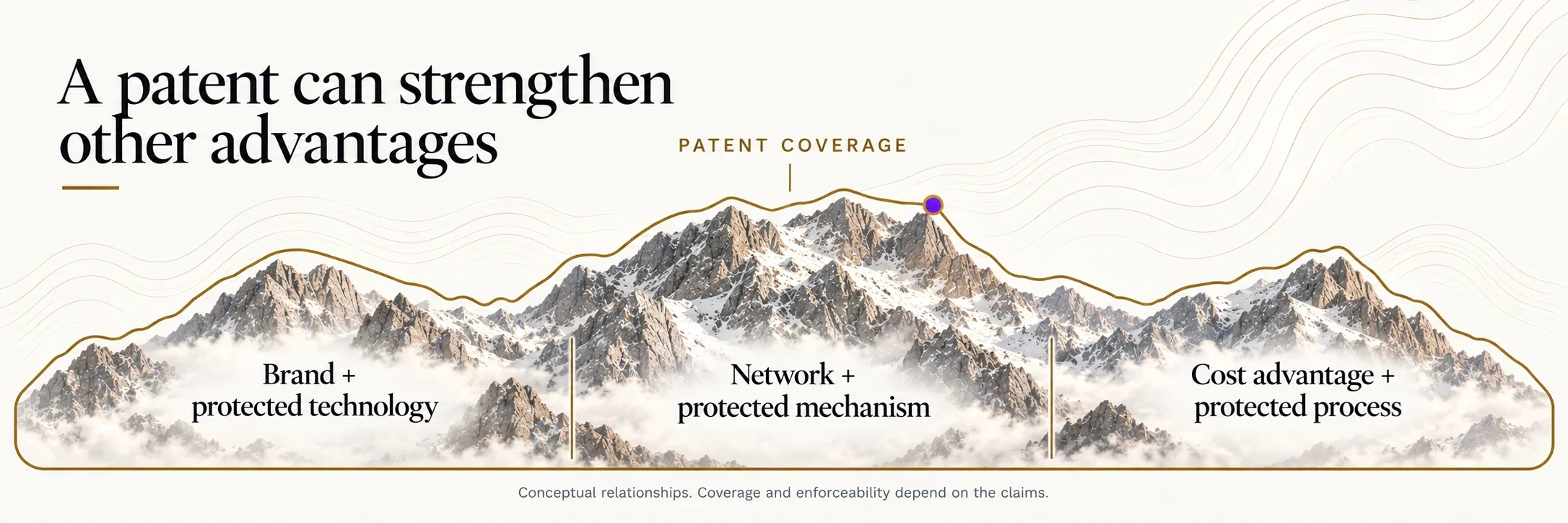
It compounds the other moats. A brand plus a patent beat either alone in the funding data. A network built on a patented mechanism is harder to clone. A cost advantage that rests on a patented process can't be copied by the next factory. Rather than replacing the other six, the patent can make each of them harder to take. Protection follows the granted claims and their enforceability, not the breadth of the idea.
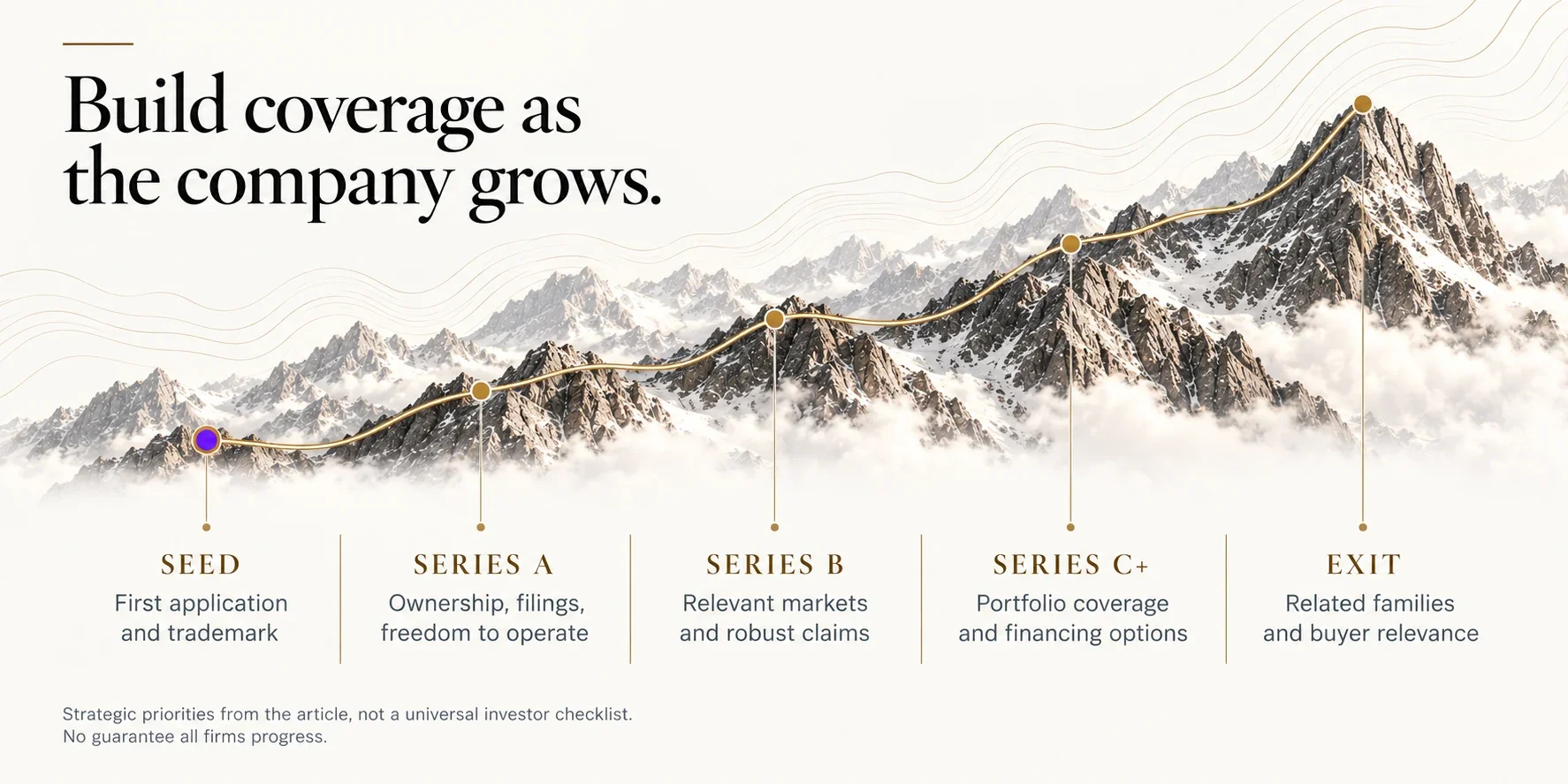
How the patent moat fits the funding path
Seed. One well-drafted application and a trademark. Money is tightest here and the signal is worth the most. Watch disclosure: the US gives inventors a one-year grace period after their own public disclosure, but Europe and most other major offices don't. File before the demo, the paper, or the launch.
Series A. Investors expect filed applications, a credible answer on freedom to operate, and signed invention assignments from every inventor. Missing assignments are a common diligence finding and cheap to fix early.
Series B. Depth over count. Filings in the markets that matter, and claims written to be enforced.
Series C and beyond. The portfolio becomes a moat and, depending on accounting treatment, an asset that can help secure debt.
Exit. In our experience, acquirers look for families of related patents with coverage in the markets where they sell.
Get the first filing right
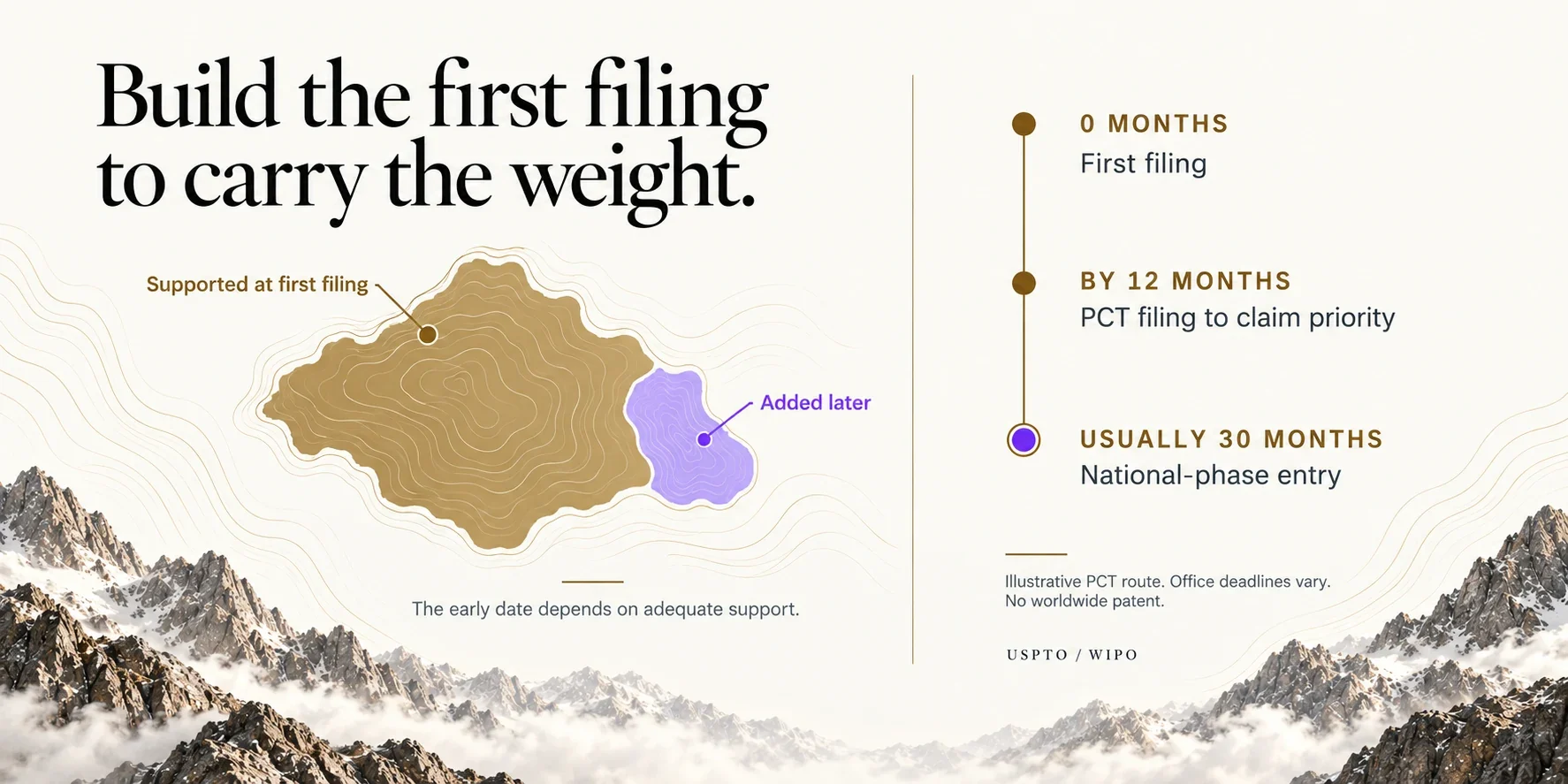
A US provisional application is the cheapest way to start. As of September 2026 the government fee is $65 for micro entities, $130 for small entities, and $325 undiscounted. It secures a filing date, the right to say “patent pending,” and 12 months to file the full application.
A provisional supports only what it actually describes, so anything the full application adds receives the later date. Draft it as though it were the full application. If foreign filing is possible, the Patent Cooperation Treaty is a filing route rather than a worldwide patent: you generally file within 12 months to claim priority, and national-phase entry is usually at 30 months from the priority date, with office-specific variations. That defers most country-by-country cost, which buys time to raise the money those countries will need.
Where trade secrets fit
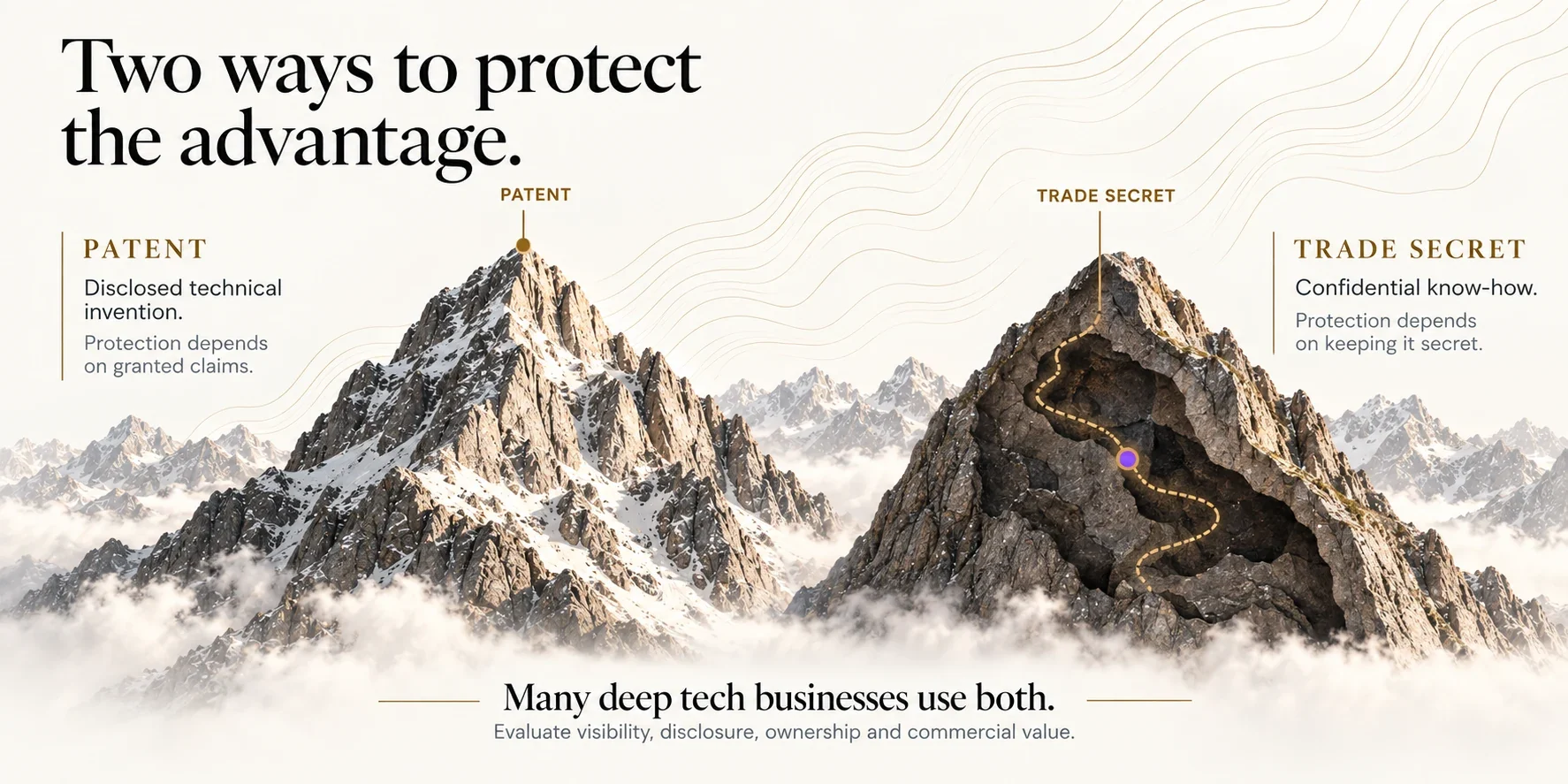
A trade secret is the other form of IP moat, and it has a place. It costs nothing to file and has no fixed expiry, though it requires continued qualifying secrecy and real protection measures. Trade secrets can have financing and diligence value, but their secrecy makes identification, valuation and controlled disclosure more demanding, and they do not prevent a competitor from independently developing the same method. Our rule of thumb: if someone could learn your advantage by taking your product apart, patent it. If it's an internal process no outsider can observe, secrecy may serve you better. Most deep tech companies need both.
Five mistakes we see most
- Describing moats you haven't built yet, when a filing would give investors one they can examine.
- Disclosing before filing, which outside the US can forfeit patent rights.
- Filing a thin provisional to grab a date, which protects only what the document supports.
- Filing abroad for optics, when the signal rarely covers the cost.
- Leaving inventor assignments unsigned until diligence, when the fix becomes awkward.
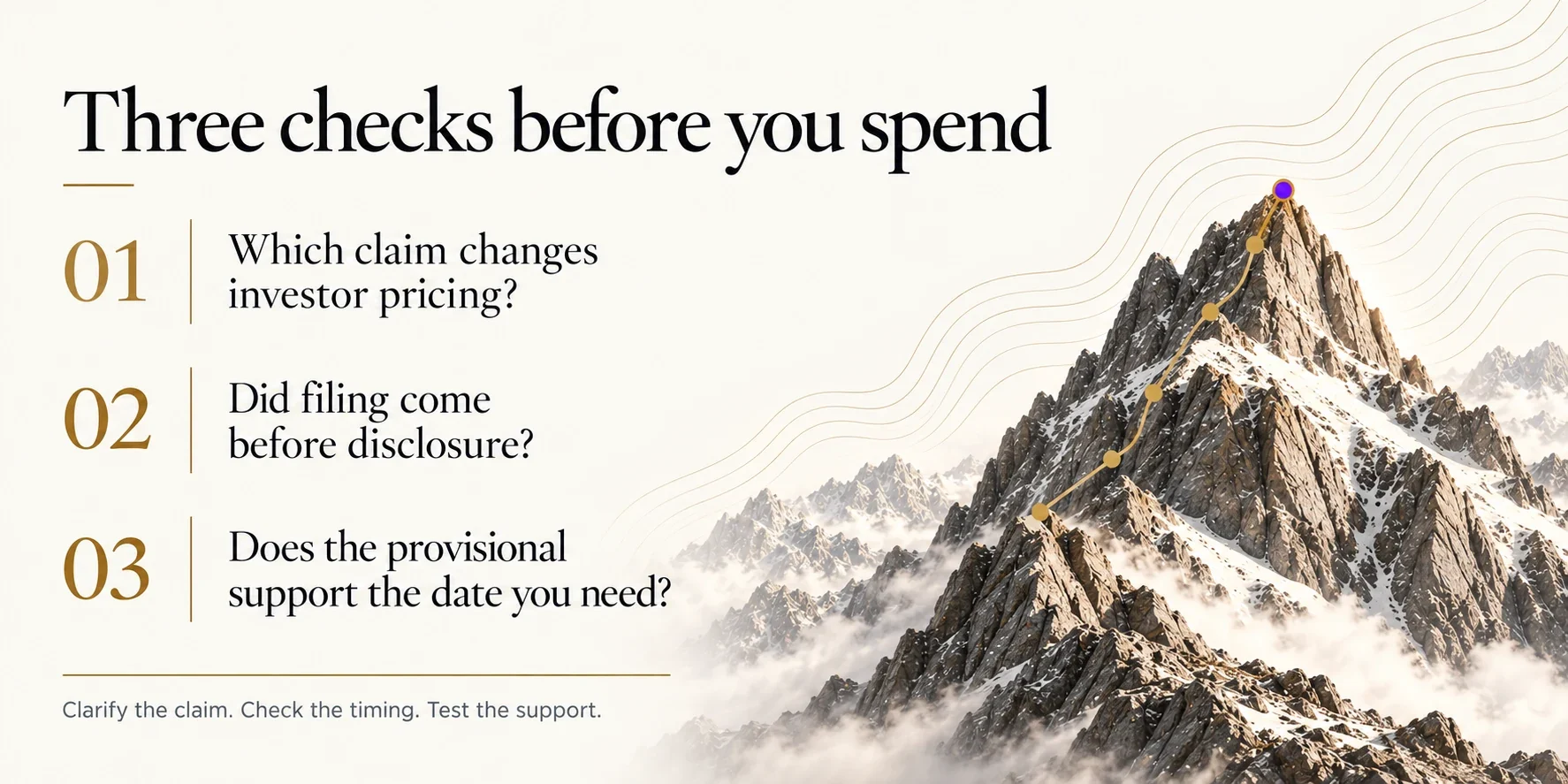
Three questions before you spend
- Which single claim, if granted, would change how an investor prices this company?
- Have we said, shown, or shipped anything publicly, and did we file first?
- If we might file abroad, is the provisional strong enough to hold our filing date?
If any answer is fuzzy, start there.
We've expanded these into a six-question pre-filing checklist you can work through with your team: The Pre-Filing Red-Team Checklist.
What this changes
Six of the seven moats are earned over years, with customers, and can be lost the same way. The seventh begins with a filing you can make before your first sale, and the evidence that it improves your odds with investors, lenders and acquirers at every stage is among the strongest in the field.
That's the work Kenorai does. We map the open ground around an invention, find the claims worth owning, and then attack them the way an examiner or an opposing party would, before a practitioner drafts a word. We call it Adversarial IP.
Which of the seven moats did your first investor actually ask about?
About Kenorai
Kenorai is a patent strategy consultancy for deep tech companies, founded by Jan Gerards, Managing Partner, and Seth Everson, Co-Founder and Principal Technical Partner. Together, our founders bring 16 years of patent experience.
We work alongside any patent attorney or agent you choose. In certain technology areas, our founders also have a 12-year working relationship with a preferred patent agent we can bring in when it fits. That relationship is non-exclusive, and we receive no referral fees or other compensation from any patent agent or firm.
We don't file patents. Kenorai is not a law firm and does not provide legal advice. This is the third article in our series on patent strategy for deep tech founders.
Sources
- Ocean Tomo, Intangible Asset Market Value Study, 2025 release. oceantomo.com
- USPTO, “Intellectual property and the U.S. economy in 2024”, August 2026. uspto.gov
- Farre-Mensa, Hegde and Ljungqvist, “What Is a Patent Worth? Evidence from the U.S. Patent Lottery”, Journal of Finance 75(2), 2020. doi.org/10.1111/jofi.12867
- EPO and EUIPO, “Patents, trade marks and startup finance”, October 2023. euipo.europa.eu
- Haeussler, Harhoff and Mueller, “How patenting informs VC investors: The case of biotechnology”, Research Policy 43(8), 2014. The 76 percent figure is from ZEW Discussion Paper 09-003, 2009. ftp.zew.de
- Hsu and Ziedonis, “Resources as dual sources of advantage”, Strategic Management Journal 34(7), 2013. The 28 percent valuation figure is from the Academy of Management Best Paper Proceedings, 2008. doi.org/10.1002/smj.2037
- Mann, “Creditor rights and innovation: Evidence from patent collateral”, Journal of Financial Economics 130(1), 2018. doi.org/10.1016/j.jfineco.2018.07.001
- USPTO Fee Schedule. uspto.gov/fees
- WIPO, PCT Contracting States. wipo.int
No comments yet