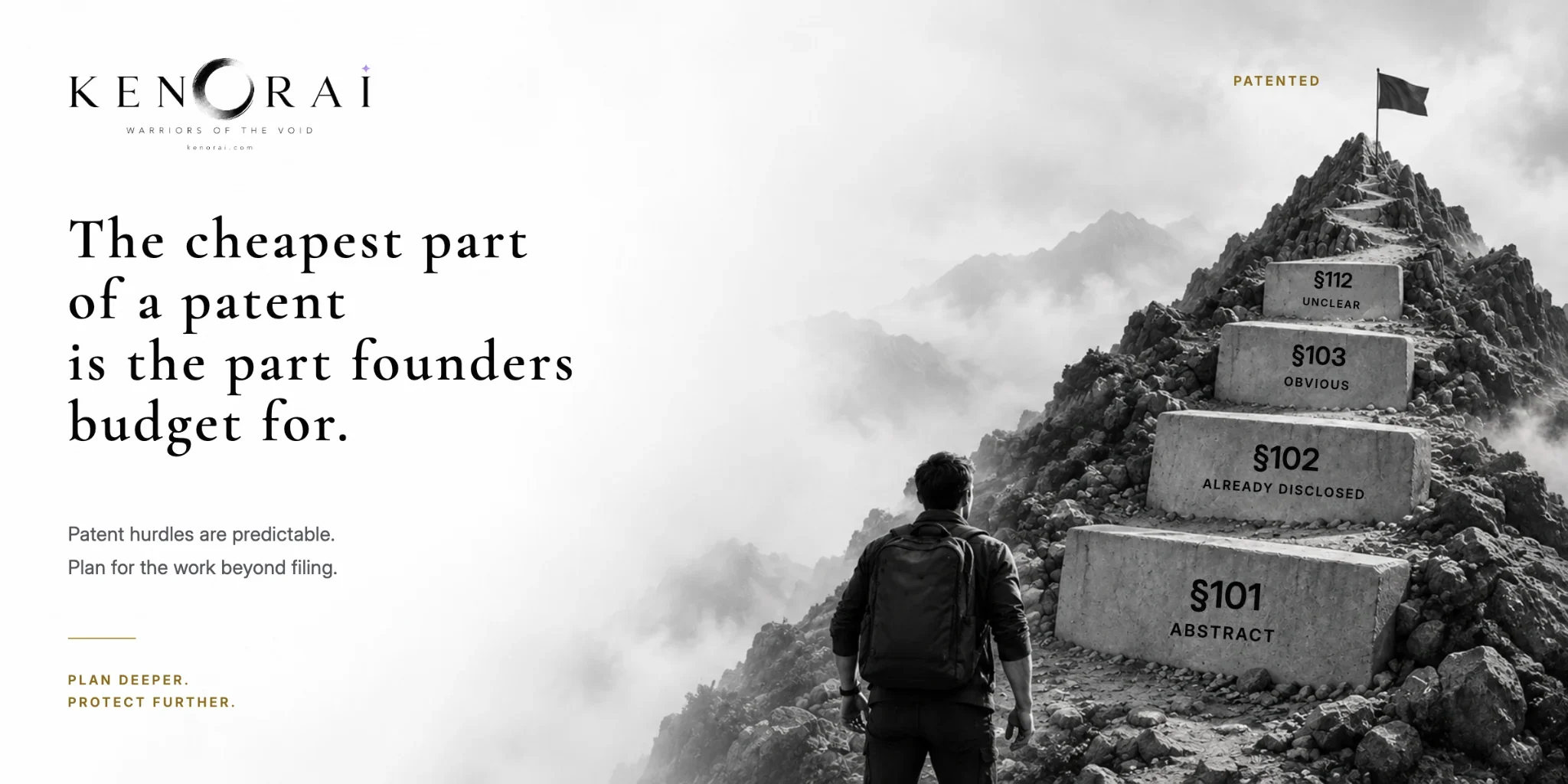
For a large entity, the USPTO's basic filing, search, and examination fees on a utility application total $2,000. Small entities pay less.
That's the number most founders put in the plan. It's also the smallest number in the story.
The odds you're actually filing into
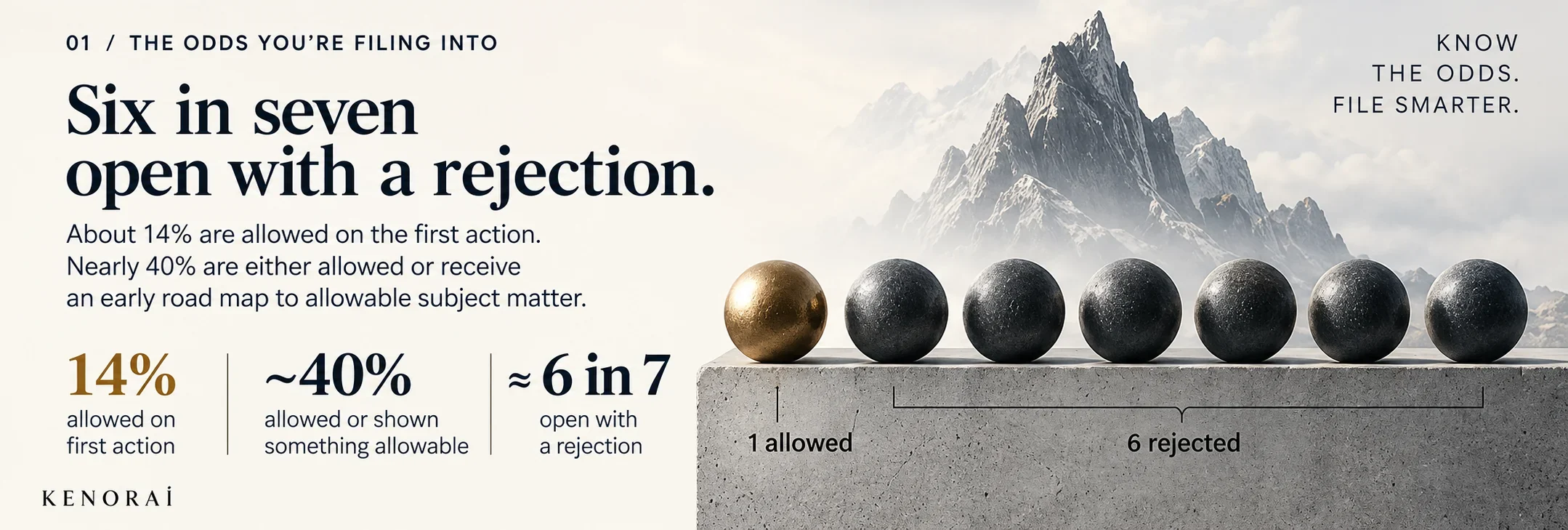
Dennis Crouch at Patently-O puts first-action allowances at about 14 percent. So roughly six in seven applications open with a rejection.
The same analysis carries a more useful finding. Nearly 40 percent of first actions either allow the application or point to something already allowable. That second group matters a great deal, as we'll get to.
Each rejection starts a cycle. Your attorney or agent reads the office action, decides how to answer, amends the claims or argues, and files a response. Then you wait. If the examiner isn't persuaded, a final rejection follows, and every option after that costs more.
What a round actually costs
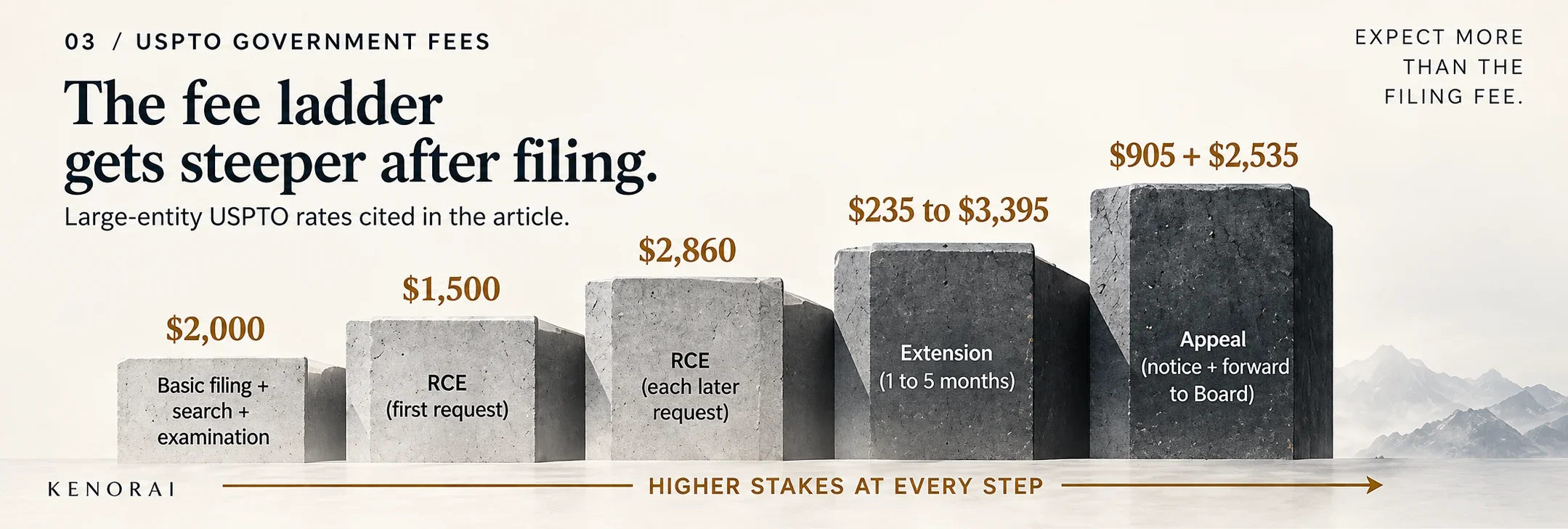
Government fees at current USPTO large-entity rates:
- Request for continued examination: $1,500 the first time, $2,860 for each one after.
- Extension of time to respond: $235 for one month, rising to $3,395 for five.
- Appeal: $905 for the notice, plus $2,535 to forward the appeal to the Board.
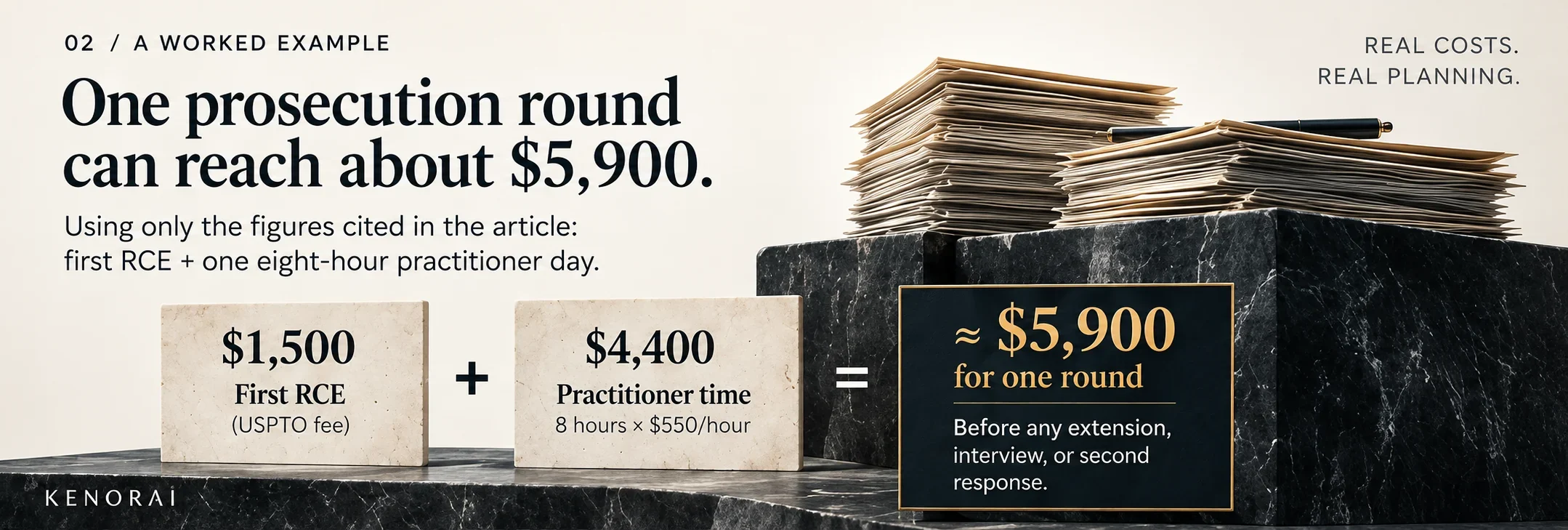
Professional time sits on top. In a July 2026 Federal Register notice, the USPTO cited AIPLA's 2025 Economic Survey for an average IP billing rate of $550 an hour across all firms.
A rough illustration, using only those figures: one continued examination request plus one eight-hour day of practitioner time comes to about $5,900. That's one round, before any extension, interview, or second response. Complex applications rarely stop at one.
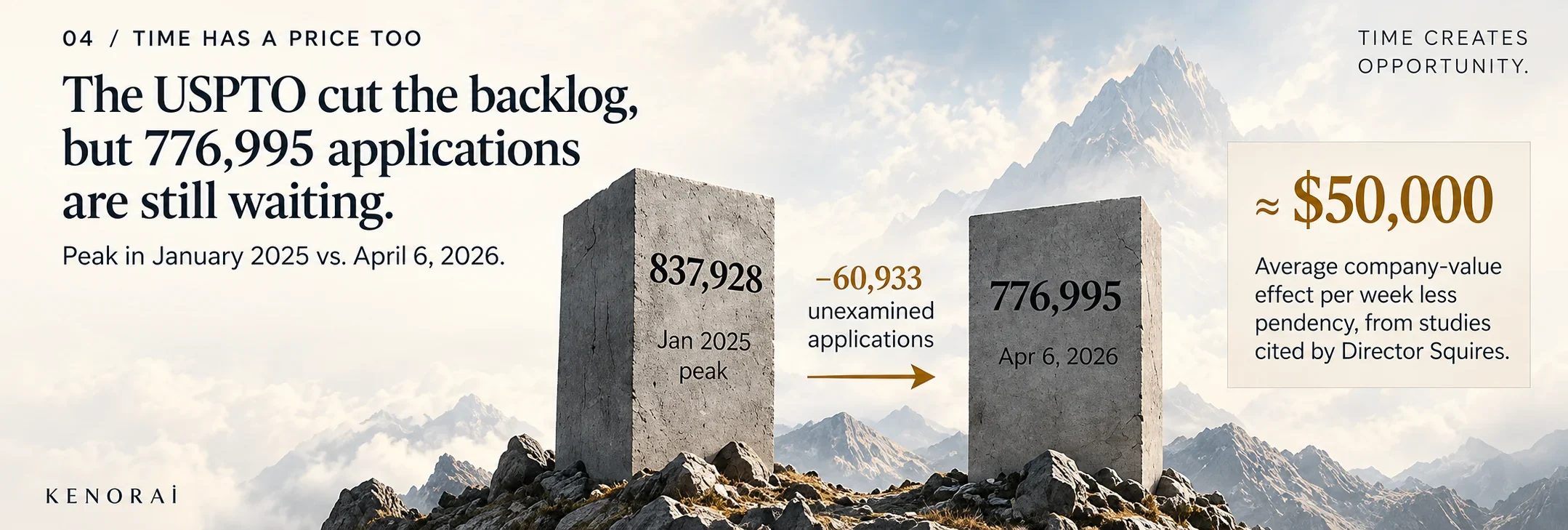
Time has a price too. As of April 6, 2026, the USPTO's backlog of unexamined applications was 776,995, down from a peak of 837,928 in January 2025. Director Squires, announcing the drop, pointed to studies suggesting a one-week reduction in pendency adds roughly $50,000 to a US company's value on average. Whatever the right figure is for your company, every extra round moves your issue date, and investors, acquirers, and competitors are watching it.
The four rejections
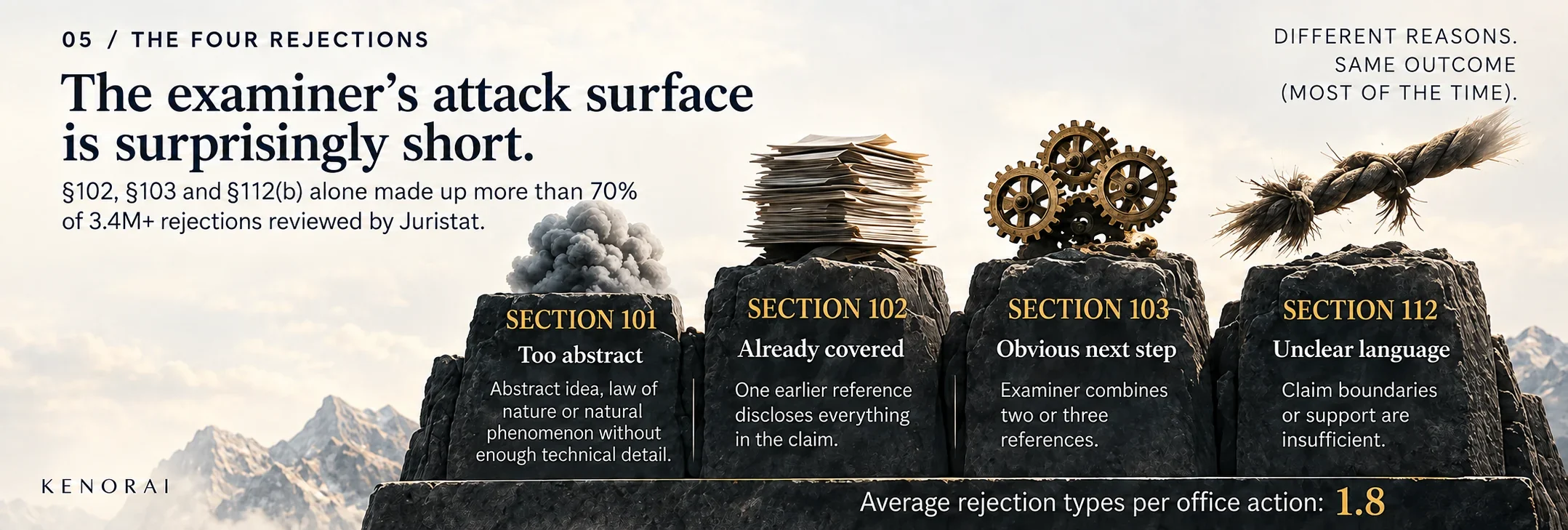
Rejections aren't random. Juristat reviewed more than 3.4 million of them, on applications filed from 2014 to 2018, and found that §102, §103, and §112(b) alone made up more than 70 percent. Add §101 and you have the four that matter.
1. Too abstract to patent (§101). The examiner says the claim is directed to an abstract idea, a law of nature, or a natural phenomenon, without enough beyond it. Software and AI claims are especially exposed. The usual cause is a claim that states what the system achieves rather than the specific technical way it achieves it.
2. Already covered (§102). A single earlier document, whether a patent, a paper, or a product manual, discloses everything the claim recites. This is usually a search problem. The reference could have been found before filing, and nobody found it.
3. An obvious next step (§103). No one reference shows the invention, but the examiner combines two or three and argues a skilled engineer would have put them together. It's the most common rejection and the hardest to argue past, because obviousness is a judgment call and the examiner makes it first.
4. Unclear claim language (§112). Terms in the claim lack clear boundaries, or the claim reaches past what the application describes. These tend to come from drafting under deadline pressure, or from broadening claims late without revisiting the specification.
One office action often cites several at once. A 2017 USPTO working paper covering millions of office actions found an average of 1.8 rejection types per action. Expect rejections. The real planning question is which ones, and whether you saw them first.
Four habits behind the extra rounds
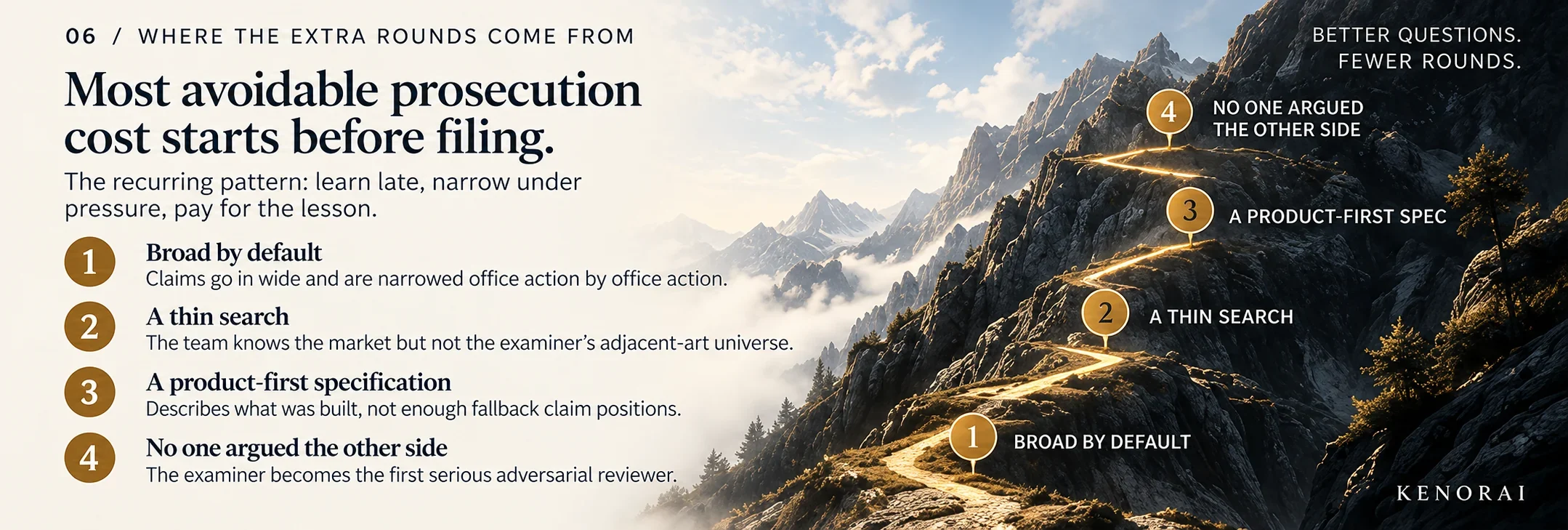
Broad by default. Claims go in wide and get narrowed under pressure, one office action at a time. Each cut is a costly way to learn what a better search would have shown up front.
A thin search. The pre-filing search was light, or skipped because the team “knows the space.” Examiners search patents, published applications, and technical literature, and they pull from adjacent fields. A competitor map covers far less ground than that.
A spec written for the product. The specification describes what you built rather than supporting the claims. When claims need to move during prosecution, there's nothing in the spec for them to move to.
No one argued the other side. The first serious attack on the claims came from the examiner.
The broad versus narrow trade
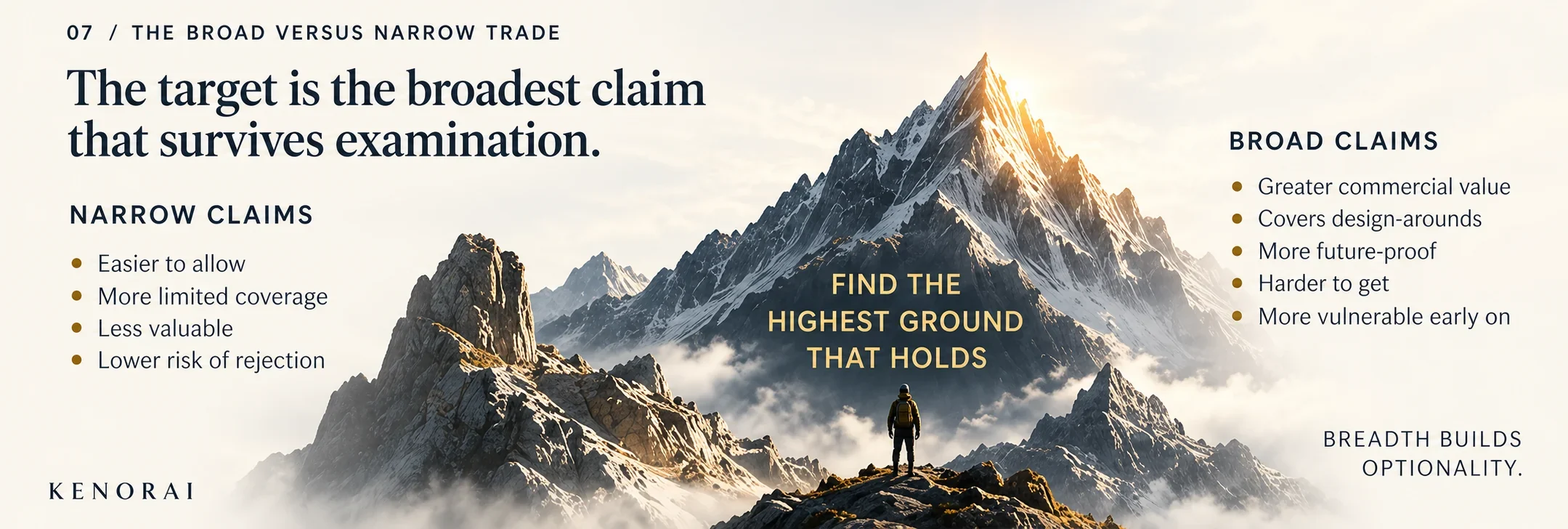
Broad claims are worth more. They reach design-arounds, future versions, and competitors who took a slightly different route. They're also the likeliest to be rejected.
Narrow claims get allowed, and can be close to worthless. A patent covering only your exact implementation invites a competitor to change one detail and walk around it.
The target is the broadest claim that survives examination. That call depends on the invention and the art unit, and no formula settles it. What you can choose is when to make it: before filing, with evidence, or one office action at a time.
The timing matters. Crouch followed about 382,000 utility applications that received a first substantive action in 2023 and checked their status three and a half years later.
- Allowed on the first action: 98 percent became patents.
- Rejected, but told which claims were allowable: 93 percent.
- Rejected with nothing identified as allowable: 68 percent.
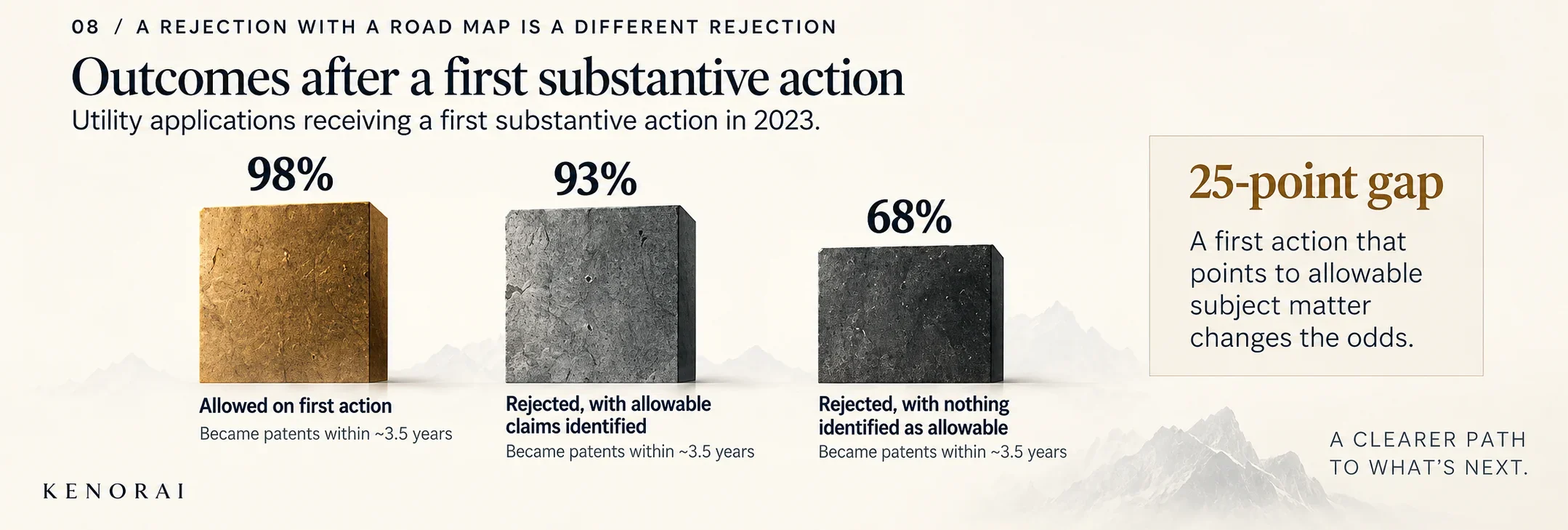
A rejection that hands the examiner something allowable is a very different rejection from one that doesn't.
The 25-point gap between those last two groups is the case for filing claims that give the examiner something clearly allowable, while still covering ground worth owning.
Red-team your claims before the examiner does
The fix is to run the examiner's process on your own claims first.
Search like an examiner. Go beyond competitor products. Cover patents, published applications, and technical literature, including the adjacent fields an examiner is likely to combine.
Attack each claim position on all four grounds. Is it tied to a concrete technical mechanism, or could it read as an abstract result? Does any single reference already cover it? Which two or three references would an examiner combine, and what's your answer to that combination? Is every term clear, and does the application support every limitation?
Rank what survives. Some positions will collapse. Some will survive only narrowly. A few will hold at meaningful breadth. Score each on two axes, likelihood of surviving examination and commercial ground covered, then lead with the positions that do well on both. Know your fallbacks before you need them.
Hand your practitioner a better starting point. The deliverable here is a sharper set of claim positions, the prior art that shaped them, and counterarguments already worked through. Drafting and filing still belong to your practitioner, who now starts ahead.
This won't guarantee an allowance. Examiners differ, and obviousness always involves judgment. It removes the rounds you could have predicted, so the ones left are about genuinely hard questions.
Where your patent attorney or agent fits
Preparing and prosecuting an application on a company's behalf is the job of a registered patent practitioner, and it stays that way. Red-team work improves what they receive.
Incentives are worth a moment. Prosecution is commonly billed per application and per response, and most practitioners do excellent work however they bill. A strategy view from someone with no stake in how many applications you file, or how many rounds they take, still gives you a second opinion the billing model hasn't touched.
Before your next filing
Answer these three before you spend on an application:
- What will an examiner cite against this, and have we searched for it the way they will?
- What's the broadest version of this claim we believe survives, and why?
- If our lead position is rejected, what's the fallback, and is it still worth owning?
Clear answers to all three remove some of the back and forth before it begins. If any of them is fuzzy, start there.
We have turned these into a six-question pre-filing checklist you can work through with your team: The Pre-Filing Red-Team Checklist.
If this was useful, follow Kenorai for the rest of the series on patent strategy for deep tech founders.
About Kenorai
Kenorai is a patent strategy consultancy for deep tech companies, founded by Jan Gerards, Managing Partner, and Seth Everson, Principal Technical Partner. Together, our founders bring 16 years of patent experience.
We work alongside any patent attorney or agent you choose. In certain technology areas, our founders also have a 12-year working relationship with a preferred patent agent we can bring in when it fits. That relationship is non-exclusive, and we receive no referral fees or other compensation from any patent agent or firm.
We don't file patents. Kenorai is not a law firm and does not provide legal advice.
Sources
- USPTO, Fee Schedule, effective January 19, 2025 (last revised August 14, 2026). uspto.gov/learning-and-resources/fees-and-payment/uspto-fee-schedule
- USPTO, “USPTO turns the corner on unexamined patent application backlog reduction,” April 10, 2026. uspto.gov/about-us/news-updates
- Federal Register, July 17, 2026 (Doc. 2026-14389), citing AIPLA, 2025 Report of the Economic Survey, p. F-35. federalregister.gov/documents/2026/07/17/2026-14389
- Dennis Crouch, “Rejected, With a Road Map: Allowable Subject Matter in the First Action,” Patently-O, Aug. 17, 2026. patentlyo.com/patent/2026/08/rejected-with-a-road-map
- Dennis Crouch, “Allowable, Not Allowed: What the First Action Predicts,” Patently-O, Aug. 18, 2026. patentlyo.com/patent/2026/08/allowable-not-allowed
- Juristat, “The Most Common Rejections: 102, 103, and 112(b).” blog.juristat.com/most-common-rejections
- Lu, Myers, and Beliveau, “USPTO Patent Prosecution Research Data: Unlocking Office Action Traits,” USPTO Economic Working Paper, 2017. ssrn.com/abstract=3024621
No comments yet